.:[Double Click To][Close]:.

Online CPM Advertising | Advertising blog
Showing posts with label koji wakamatsu. Show all posts

Kôji Wakamatsu- 胎児が密猟する時/The Embryo Hunts in Secret (1966)- DVD5 (NTSC Format)

koji wakamatsu- the embryo hunts in secret
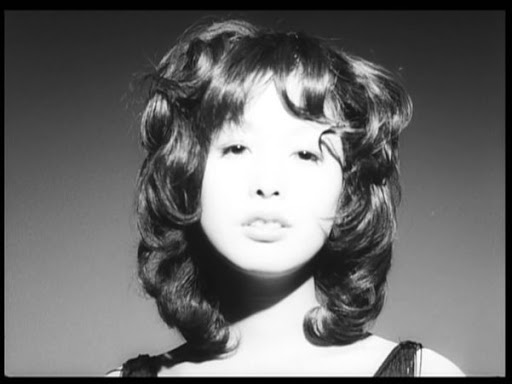
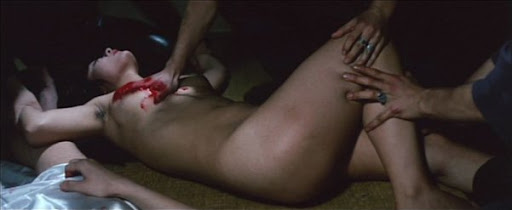
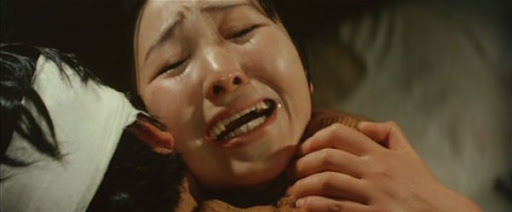
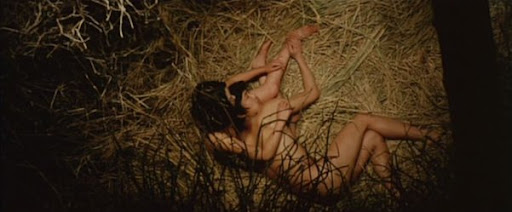
Man, does Wakamatsu know how to use shadows and perspective. The Embryo Hunts in Secret should be studied as well as watched, and if you've never seen Violated Angels, this film would be the perfect lead-in to it. They have alot in common stylistically. Enjoy another Wakamatsu masterpiece.


koji wakamatsu- the embryo hunts in secret

From esotika.blogspot.com:

It's ironic that the films of the 60s and 70s steeped in sado-masochism are today relegated to the trash heap by serious film connoisseurs, as most, through the depiction of the relationship and often times quirky dialogue, will rise to the same level of intellectualism as the 'heady' art films of the time. And while it remains true that, through a lack of understanding, many individuals regard the sadomasochistic pinku films of Japan's cinematic golden age as overly misogynistic and worthless, many of these titles well deserve a second look.

Koji Wakamatsu is often considered an enfant-terrible of Japan's studio system early on in his career, and his experiences in the studio affected him so much that he abandoned it all together, financing his films through outside sources so he would have total control over his final product. The Embryo Hunts in Secret, while not as politically charged as many of Wakamatsu's films, retains it's own sense of poetry through it's depiction of a harrowing situation.

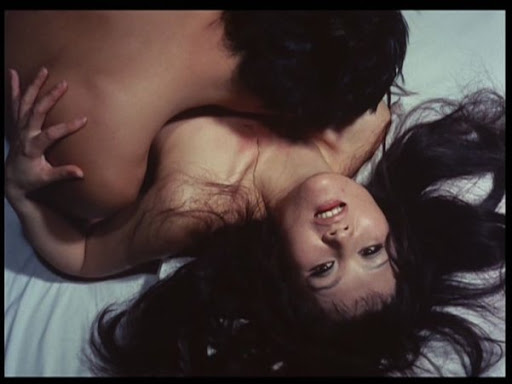
The film opens with a man and woman passionately groping each other in a car; outside, it is pouring down rain. The man grabs for the woman's sex, but she denies him the pleasure, insisting that they go inside. The man takes the woman to his apartment. It turns out that the man is the owner of a department store where Yuka, the woman, works in the men's clothing department as a sale girl. The two know little about each other, other than what is knowable from an outsider perspective; they know their power relations in the business, and they know they are attracted to each other.


koji wakamatsu- the embryo hunts in secret

The woman takes a bath, and after some fairly rough sex, the man starts to ask Yuka fairly personal questions about her own sex. How many men has she done it with before? Is it always 'like this'? Yuka feels uncomfortable answering the questions, but through the mans force she eventually complies with an answer. After the sex the man gives the woman a sleeping pill so she can fall asleep and wake up by 11:30 the next morning; she has a lunch date. While the woman is getting ready for bed, the man comments on how she 'looks just like her,' though at this point in the film we're not sure who it is that Yuka resembles.

Once the woman is in bed and more or less passed out, the man ties her arms and feet to the posts of the bed, and then whips her. While whipping the woman he exclaims commentary on his relationships with all the women formerly in his life; his mother who hung herself after the war, his wife who left him so she could have a baby. The man seems to consider life more or less pain, and it is his goal to teach the woman this, to force her into becoming his wife (as he is still hung up on the wife who abandoned him in order to have a child).

When the woman wakes up the next morning she is appalled to find her body covered in bruises from the whip. The man, in a demeaning gesture, throws 30,000 yen at her and says that it was worth it. The woman rejects the money and begins to leave the apartment, but the man breaks down. He virtually throws himself at her asking her to stay, saying that she can have the apartment for herself, and offering his love. She still rejects the man, so through use of force he gets her back into the bed, where he once again ties her down.


koji wakamatsu- the embryo hunts in secret

Through an extended period of time the audience is given a window into the arena in which the man is attempting to make Yuka his slave, his 'dog.' He rewards her with food and water when she behaves, and punishes her with the whip when she doesn't. All the while still recounting his family relationship, his oedipal relationship with his mother, and his estranged relationship with his wife, all at the cost of his utter rejection of a child.

Time passes and the woman seems to be becoming more and more passive, but in actually, once the man lets his guard down, Yuka gets her revenge, coming out on top.

The film is very claustrophobic, set entirely in the man's apartment, with the only characters being the man and the woman themselves, with occasional flashbacks of the man's wife (who may very well be the same actress playing Yuka) and a brief flash of his mother. Such claustrophobia severely helps in extending the severe atmosphere in which the two characters are existing.

Returning to a comment I made at the beginning of this review, Wakamatsu imbues a large amount of poetry into this claustrophobic nightmare. The first bold move Wakamatsu makes is using a classical score to back the action, creating an awkward sort of tension that mirrors the dichotic state of the male protagonist. At one moment the man will be viciously torturing the girl, the next crying in her lap while he reminisces on his past. The dialogue is also beautiful at times, intensely focused, the viewer gets the opinion that the man has no other thoughts entering his head outside of his entire warped view of birth and the female gender. The beauty of the dialogue stems from the fact that the man's thought process borders on the metaphysical at time, approaching abstract concepts in relation to what he needs things to add up to.


koji wakamatsu- the embryo hunts in secret

As usual for a Wakamatsu film, the cinematography and level of experimentation is full force. The stark black and white photography will segue into bleached out whites to indicate the passing of time, Wakamatsu will hold freeze-frames at specifically relevant climactic moments, and during one scene the audio is dropped completely while the viewer watched the woman screaming in pain. It all adds up to a unique vision of the utterly claustrophobic world view; everything that exists within the frame is consistent.

Another thing to comment on is that a majority of other reviews available on the internet of the film were written by non- Japanese speaking individuals who watched the film without subtitles. This tends to lead to an interpretation that the man and woman in the flashback scenes are not the business man and his wife, but rather the business man's father and mother. This is important to note, as if that were the case the film would lend itself to falling back on the old "runs-in-the-family" excuse that relates to spousal abuse, which isn't half as complicated (and expressively more cliched) as what is actually occurring in Wakamatsu's film.


koji wakamatsu- the embryo hunts in secret

Also, as a strike against those who accuse this film (or even pinku films in general), it is very obvious, as the film plays out, that the woman is the one who's in control of the man. All of the man's actions are directly related to his response, and obsession, with Yuka, and even women in general. And in the ending, in a far more complicated manner than a straight-forward revenge flick, Yuka does get a form of "revenge," but it's not so much of 'revenge,' per se, as it's really more of a metaphorical 'return to the womb' (in direct connection to the embryo of the films title) for the man. The woman has enveloped this man who was trying to use his obsession to control her.

While being a remarkable film in itself, it helped Wakamatsu pave the way to his further, more developed and important films such as 1967's Violated Angels and what could be considered his masterpiece (in regards to stylistics and character depiction), 1969's Go Go Second Time Virgin. There are not many of Wakamatsu's films available with English options, but as the number increases, it's more and more possible to view Wakamatsu as the genius auteur that he really was.


koji wakamatsu- the embryo hunts in secret

Technical Information:

Title: 胎児が密猟する時/Taiji ga mitsuryô suru toki/The Embryo Hunts in Secret
Year: 1966
Country: Japan
Director: Kôji Wakamatsu

Source: Retail DVD5
DVD Format: NTSC
Container: .iso + mds
Size: 3.62 GB
Length: 01:12:54
Programs used: ImgBurn

Resolution: 720x480
Aspect Ratio: 2.35:1
Video: MPEG2 @ ~5800 kb/s
Frame Rate: 29.97 fps

Audio: 日本語/Japanese- Dolby AC3 @ 448 kb/s
Subtitles: English, Italiano

Menu: Yes
Video: Untouched
DVD Extras: Wakamatsu interview (Japanese only)


koji wakamatsu- the embryo hunts in secret

(Use JDownloader to speed up downloading and avoid file stalls.)

胎児が密猟する時 Megaupload Link
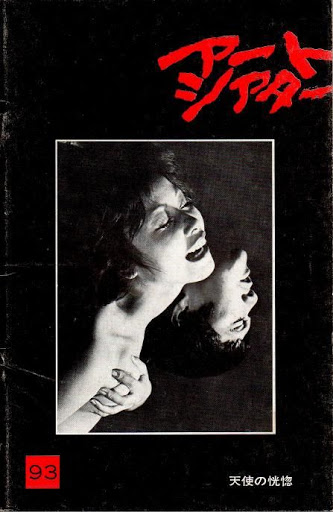


Kôji Wakamatsu- 天使の恍惚/Ecstasy of the Angels (1972)- DVD5 (NTSC Format)

koji wakamatsu- ecstasy of the angels
Ecstasy of the Angels in dub. There's even "shit that blows up!" for all the bro's....


koji wakamatsu- ecstasy of the angels

From Donato Totaro at Hors Champ:

Koji Wakamatsu is one of the more important directors to have worked in the pink film (pinku eiga), a genre of softcore, dramatically charged films which were dominant on the Japanese domestic scene in the 1960’s and 1970’s (the roman porn were a more radical and explicit subset of the pink film). The Japanese studios who produced these films, including Nikkatsu, were reluctant to distribute these films abroad, for fear of the sort of image the films would project of Japan. Seeing these films today one must conclude that it was not the more obvious sexual display that worried the Japanese, but the radical anarchist politics of the films, perhaps above all else, often compounded by violent sadomasochism, and the undercurrent of misogyny.

For this is what strikes one the most when watching the excellent recent DVD release of Wakamatsu’s Ecstasy Of The Angels. The film is a Japanese New Wave politico-anarchist fable with thin-bare plot that revolves around a group of young terrorists who call themselves by the names of the week and their organization by the name of months (the Four Seasons Association). The two months which represent this film’s political action are October, named after this troupe’s leader, and February. These two months are no doubt an homage to the Russian revolution, which was split in two. February 1917 marked the first revolution where the Tsarist government was overturned, and October 1917 marked the second revolution where the Communist Bolshevik Party overthrew Kerensky’s Provisional Government. There is no sense of successful operation or revolution in this film, however, or a similar sense of a tightly organized outfit. Instead the anarchists yell and scream at each ther, have sex at the drop of a hat, or sit around dourly in a cabaret listening to a female torch singer.


koji wakamatsu- ecstasy of the angels

The Four Seasons Association led by their 'blind' leader October

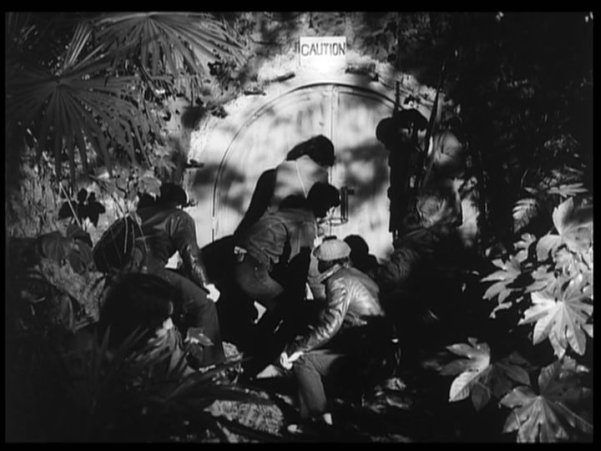
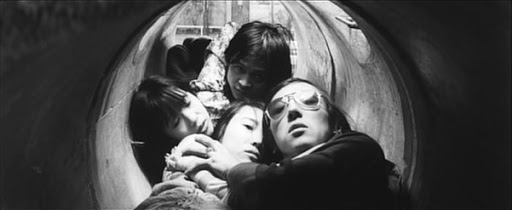
The only bit of conventional plot action occurs early on when the group break into an underground US military base and steal some weapons. The sign over the door reads “Weapons Wearhouse!” The success is shortlived as American soldiers meet them outside the tunnel and engage them in gunfire. Three members are killed (Tuesday, Wednesday and Thursday) and one, October, is blinded by the gunfire.

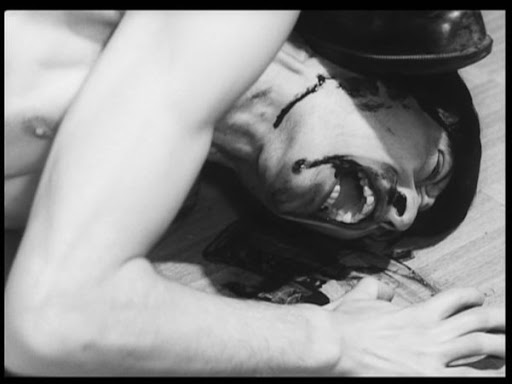
The group is disbanded into other cells, but decide to go at it alone when they learn that they were set up by the Association. A couple from the surviving group hold out in an apartment, where they have stashed the weapons. They are soon visited by a competing terrorist outfit who tell them that the “Fall plan” is over and the “Winter one” is in effect. This is the film’s first truly impressive setpiece. The intruders, led by a dark-glassed, leather jacketed sadist are ruthlessly efficient militants. They begin by trying to beat the whereabouts of the weapons out of the man. When the beating doesn’t prove successful the dark-glassed leader of the “Winter” group sticks a pen into the woman’s thigh and keeps pressing and twisting until she faints. He then tells one of his men to rape the woman until she talks. The beaten man staggers over to the woman, pushes the rapist off, and tells them where the weapons are stashed (under their floorboard).


koji wakamatsu- ecstasy of the angels

Although the film periodically shifts to color, this scene is in B/W, which gives the violence more of a performance art feel, with the dark, thick liquid smeared along the walls and across the victims lips, nose, and face.

The shifts from B/W to color may in fact be a hommage to Lindsay Anderson’s anarchist classic of 1969 If, which is infamous for its arbitrary shifting between color and black and white film stock.

From this point on the film alternates between scenes of sex ennui, cabaret ennui (2 scenes, the opening and one near the end) and heightened scenes of tension between the remaining group members. Although the film has much in common with Wakamatsu’s contemporary Seijun Suzuki, another pink film expert, it feels Godardian in that there is an affinity for the political ideals of the central protagonists, but also a comical awareness of the fallibility of any such insular political movement. Rather than ideological banter, the anarchists sit around spouting coded dialogue that means nothing to the audience (all the actions, characters, political projects are referred to by the names of days, months, and seasons). Tellingly, one of the leaders, October, is now blind, another member is deaf, a third is a woman whose sole function seems to be sexual, and a fourth is an eager yet niave student-type who represses his sexuality at every turn. In one scene he is particularly struggling with the political cell's breakdown and his own insecurities and self-doubts. This sense of identity crisis is played out against the backdrop of cheap sexuality. During the young activists moment of doubt another member enters the apartment with two hookers and begins a pornographic photo shoot. He asks the young man to strip down and join the photo shoot. As one of the women is about to perform fellatio his unease takes over and he refuses the advances.


koji wakamatsu- ecstasy of the angels

As David Desser notes, “A contract director for Niikatsu, he [Wakamatsu Koji] directed twenty films in a two-year period, 1963-65. What turned out to be his last film for the company [Secret Act Inside Walls, 1965] found Wakamatsu entering the area pioneered by Imamura Shohei and becoming a growing concern for Oshima, the connections between sexuality, identity, and politics.” (Eros plus Massacre: An Introduction to the Japanese New Wave Cinema, Bloomington and Indianapolis: Indiana University Press, 1988, p. 99).

The film’s visual style is low-tech expressionism achieved with stark lighting, and static long takes with deep focus for interior scenes, mixed with exterior shots of moving hand held camera. The opening scene at the cabaret which introduces the four characters of the ultra-left paramilitary group the Four Seasons Association, establishes the film’s off-kilter tone. A woman sings on stage while at a table sits a disinterested group of three men and a woman. Wakamatsu cuts from CUs of the singer to high angle establishing shots of the bar, then to a medium shot of the table which is then punctuated by a slow dolly in to one of the seated men. All the signs, especially the repeated slow dolly in shots, suggest the portence of violence. We may even think we are in a Yakuza film, and half expect the quiet to be interrupted by a burst of violence. But nothing happens.


koji wakamatsu- ecstasy of the angels

By contrast, in the earlier described setpiece a romantic liason between a couple is interrupted by a knock on the door which leads to an eruption of violence. The rash act of violence conditions the audience to expect the unexpected, and at two other points in the film there is a door knock which causes us unease. The film ends with an interesting montage of the remaining militants turned flat-out anarchists planting bombs all across Tokyo in a last ditch political act of desparation before they are all wiped out by their enemies. The final credit scene runs over a hand held long take following October from behind as he makes his way through a crowded Tokyo street.

As an additional note, this film clearly influenced the later Japanese film Kichiku by Kazuyoshi Kumakiri (1997), another film which follows the disintegration of a young political-terrorist group that employs extreme violence, paranoia, and casual sex. Kichiku is actually set during the time frame of Ecstacy of the Angels’ production, the early 1970s, and both films are in effect a product of or reflection on the radical left-wing student scene in Japan circa that time period. The DVD presents the film in an excellent widescreen transfer with a clean, crisp black and white and rich, saturated colors for the few scenes in color.


koji wakamatsu- ecstasy of the angels

Technical Information:

Title: 天使の恍惚/Tenshi no kôkotsu/Angelic Orgasm/Ecstacy of the Angels
Year: 1972
Country: Japan
Director: Kôji Wakamatsu

Source: Retail DVD5
DVD Format: NTSC
Container: .iso + mds
Size: 4.08 GB
Length: 1:28:51
Programs used: ImgBurn

Resolution: 720x480
Aspect Ratio: 4:3
Video: MPEG2 @ ~5800 kb/s
Frame Rate: 29.97 fps

Audio: Japanese- Dolby AC3 @ 448 kb/s
Subtitles: English

Menu: Yes
Video: Untouched
DVD Extras: Wakamatsu interview (Japanese only)


koji wakamatsu- ecstasy of the angels

(Use JDownloader to speed up downloading and avoid file stalls.)

天使の恍惚 Megaupload Links


Kôji Wakamatsu- 新宿マッド/Shinjuku Mad (1970)- DVD5 (NTSC Format)

koji wakatsu- shinjuku mad
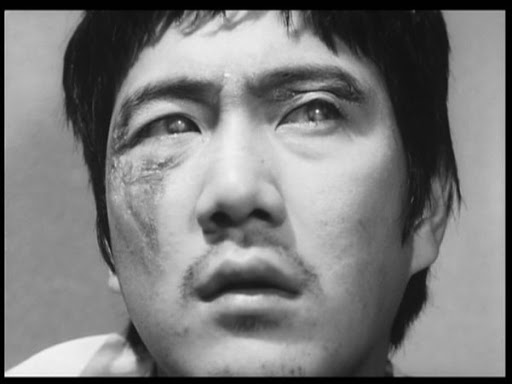
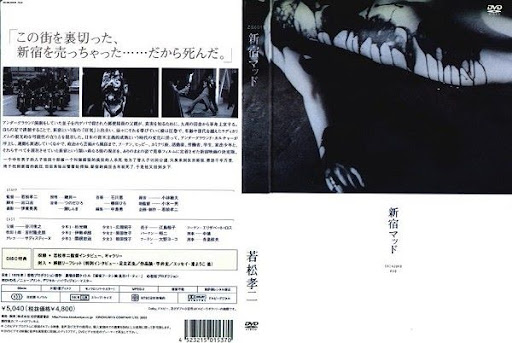
A Japanese Ballad of a Thin Man. Add this to the list of rare Wakamatsu films.


koji wakatsu- shinjuku mad

From Nicholas Rucka:

With a sensationally violent and squelchy opening that sets up the plot of a father searching for his child’s murderer through the Shinjuku underworld, Shinjuku Mad never lets up its relentless assault as the blood flies, the bodies pile and the suffocating alienation multiplies like H1N1 in a school playground, all while Japanese '70s space rock band Food Brain provides harrowing cuts of fuzzy skronk on the soundtrack. The film was embraced by college students, artists and intellectuals upon its release, for its abrasive style and its honest countercultural insight (hippies and bikers are to be equally mistrusted!) Scripted by Wakamatsu’s partner in crime and leftist political radical, Masao Adachi, this film is purportedly one of Wakamatsu’s personal favorites for its "…vicarious portrait of Swinging Shinjuku in its vibrant heyday, making full use of local landmarks…" One of six(!) films Wakamatsu released in 1970.


koji wakatsu- shinjuku mad

Technical Information:

Title: 新宿マッド/Shinjuku Mad
Year: 1970
Country: Japan
Director: Kôji Wakamatsu

Source: DVD5 Retail
DVD Format: NTSC
Container: .iso + mds
Size: 4.31 GB
Length: 1:06:10
Programs used: ImgBurn

Resolution: 720x480
Aspect Ratio: 16:9
Video: MPEG2 @ ~6200 kb/s
Frame Rate: 29.97 fps

Audio: 日本語 Japanese- Dolby AC3 @ 448 kb/s
Subtitles: English

Menu: Yes
Video: Untouched
DVD Extras: Wakamatsu Interview, Photo Gallery


koji wakatsu- shinjuku mad

(Use JDownloader to speed up downloading and avoid file stalls.)

新宿マッド Megaupload Links


Kôji Wakamatsu- 狂走情死考/Running in Madness, Dying in Love (1969)- DVD5 (NTSC Format)

koji wakamatsu- running in madness, dying in love
Right before two of our hard drives crashed (back to back), we were working on getting our Wakamatsu collection uploaded and posted. Then we lost lost mostly everything in one fell swoop. Now we're being hyper-vigilant about getting these rare treasures secured, so I'm working them into my little Rasta jag. If you're a regular around here, you already know how much we love our militant genius director...so that's why all this Wakamatsuian paranoia has set it. I'm not going to lose this shit twice. If you're also Wakamatsu fan, enjoy!


koji wakamatsu- running in madness, dying in love

From Nicholas Rucka:

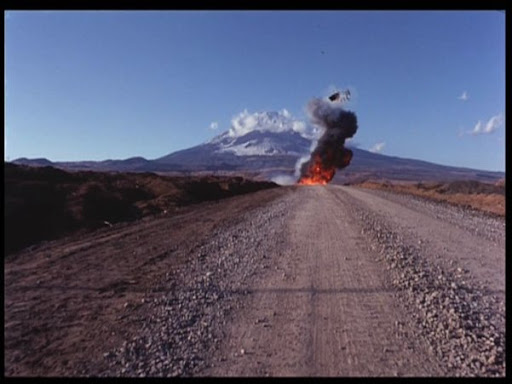
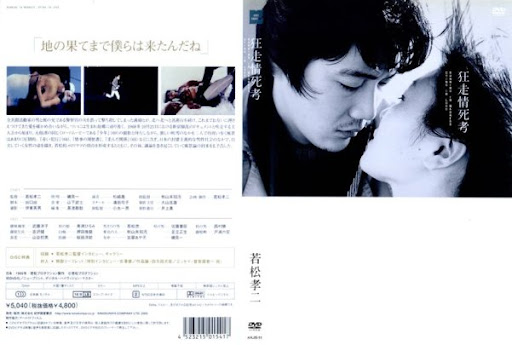
Lesser-known but still packing a mad punch, Running In Madness... tells of a student activist who is forced to flee Tokyo with his sister-in-law after he inadvertently shoots his police officer brother at a protest rally. We follow the two as they travel north to their hometown of Hokkaido, across a majestic winter landscape. Shot in a stellar psychedelic style and scripted by frequent collaborator Masao Adachi, the story was influenced by Adachi’s time spent with master director Nagisa Oshima, which led to Adachi's development of a more rigorous, formal approach to his work. Running In Madness is one of the first Japanese films to employ "Landscape Theory" (fukei-ron), a style of storytelling, according to Adachi, in which "all the landscapes one faces in...daily life, even those such as the beautiful sites shown on a postcard, are essentially related to the figure of a ruling power."


koji wakamatsu- running in madness, dying in love

Technical Information:

Title: 狂走情死考/Kyôsô jôshi-kô/Running in Madness, Dying in Love
Year: 1969
Country: Japan
Director: Kôji Wakamatsu

Source: DVD5 Retail
DVD Format: NTSC
Container: .iso + mds
Size: 4.15 GB
Length: 01:12:22
Programs used: ImgBurn

Resolution: 720x480
Aspect Ratio: 16:9
Video: MPEG2 @ ~6200 kb/s
Frame Rate: 29.97 fps

Audio: 日本語 Japanese- Dolby AC3 @ 448 kb/s
Subtitles: English

Menu: Yes
Video: Untouched
DVD Extras: Wakamatsu Interview, Photo Gallery


koji wakamatsu- running in madness, dying in love

(Use JDownloader to speed up downloading and avoid file stalls.)

狂走情死考 Megaupload Links


3 Days of the Carlos: Masao Adachi/Kôji Wakamatsu- The Red Army/PFLP: Declaration of World War- DVD5 (NTSC Format)

masao adachi- koji wakamatsu- red army- pflp- declaration of world war
Day two of The 3 Days of the Carlos, and all is not well.

You see...L&S comes from The People's Republic of Canadia, so she doesn't understand that one can't go around posting U.R.A/P.F.L.P. videos without being put on a "watch-list" here in the Good Ole U.S. of A. But does she ever listen to me?!? Hell no. She just keeps referencing me as "comrade" and questioning my "woodpile" simply because I have an uncle Sol Agronovitz. Sue me.

So you better download this stuff quick before the Men in Chrysler 300's knock down our doors over this post. She tell's me I'll die a martyr for the cause. Little does she know I'm waiting for the New Jerusalem. Oh, well...here's some more Wakamatsu. You can never have too much Wakamatsu.

masao adachi- koji wakamatsu- red army- pflp- declaration of world war

From Chris Magee at the Toronto JFilm Powwow:

In 2008 pink film legend Koji Wakamatsu released "United Red Army", the story of the creation and of the ultra-leftist armed revolutionary group in 1970 and its eventual implosion two years later. The film was a labour of love and dedication for Wakamatsu (he mortgaged his own home to finance the film and then blew it up for one particular scene) as he was and his frequent writer, co-director/ producer Masao Adachi were actively involved in the underground student movements and left wing organizations that birthed the United Red Army in July of 1971. It was in that year that both filmmakers met with United Red Army members Fusako Shigenobu and Mieko Toyama in Palestine where the two women where working in solidarity with the Popular Front for the Liberation of Palestine (PFLP). To mark the occasion Wakamatsu and Adachi created "a news film for the construction of The Red Army" titled "The Red Army/PFLP: Declaration of World War". For Adachi, who wrote Wakamatsu's most recognized films, 1969's "Go Go Second Time Virgin" and 1972's "Ecstasy of the Angels", this film would be a a declaration of purpose as three years later would leave Japan for 26 years after joining the Japanese Red Army. Based out of Lebanon he, along with his comrades in the JRA became involved with the Popular Front for the Liberation of Palestine. He was eventually arrested in Jordan in 1997 due to passport violations, served a short stint in prison and deported back to Japan in 2001. Due to his involvement with the JRA in the Middle East he has been branded a terrorist by U.S. authorities and can't travel to the United States.


masao adachi- koji wakamatsu- red army- pflp- declaration of world war

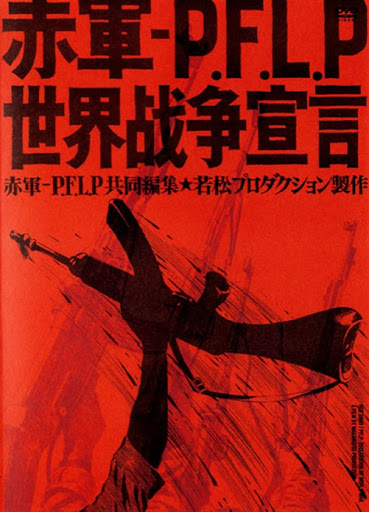
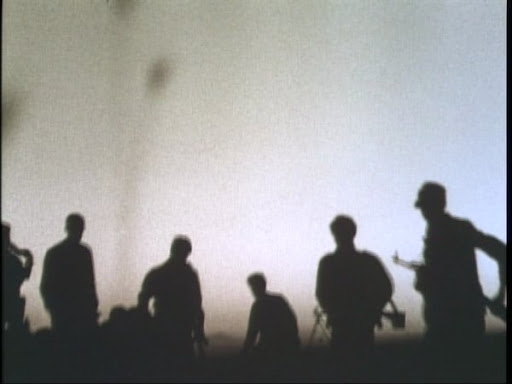
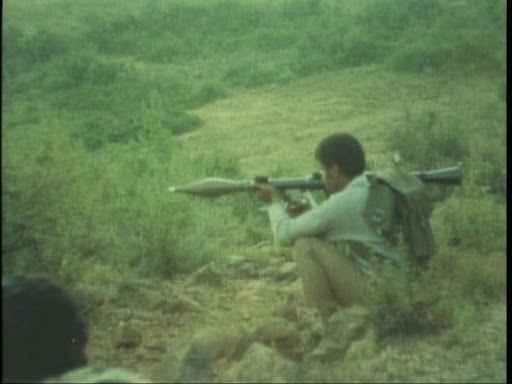
Adachi and Wakamatsu shot "The Red Army/PFLP: Declaration of World War" using their "landscape theory (fûkeiron)" formulated while making their co-directed 1969 film "A.K.A. Serial Killer". This stressed landscape over characters and situations and in "The Red Army/PFLP: Declaration of World War" this means that we're shifted from underground meetings of the JRA in Japan, PFLA training camps throughout the Middle East, and rundown communities of exiled Palestinians without any of the expected crutches of documentary filmmaking - no identifying bottom screen inter-titles, no personal interviews (only one member of the PFLP is identified obliquely as "Mr. Fedain"), in fact there are very few focused shots of people whatsoever. This may very well be due to the fact that many of the JRA and PFLP members were (and are) fugitives, but viewed through a revolutionary Communist perspective personalities aren't important. It's stressed continually by the Japanese narrator that amongst the ranks of this global revolution there are "no heroes", just the amorphous proletariat locked in constant warfare with world imperialism. If you want close-ups Adachi's and Wakamatsu's film is more than happy to oblige - with shots of rifles, machine guns and grenades. If you wanted to get a refresher on how to assemble a Kalashnikov or load a belt of ammunition into a machine gun then "The Red Army/PFLP: Declaration of World War" is definitely a help
.

masao adachi- koji wakamatsu- red army- pflp- declaration of world war

As revolutionary filmmaking and political propaganda "The Red Army/PFLP: Declaration of World War", with its loving shots of heavy artillary and onscreen, all caps slogans like "THE BEST PROPAGANDA IS ARMED STRUGGLE" and "WEAPONS ARE THE LANGUAGE OF OPPRESSED PEOPLE", is a definite success. This is undiluted revolutionary diatribe, and in a post-911 world of Iraq, "war on terror" and Al Qaeda Adachi's and Wakamatsu's film is as powerful (and to some people scary) as it was when it was originally released in 1971. The only buffer between our age of suicide bombings and terrorist plots and the early 70's struggles depicted in this film is that instead of the Koran in the hands of jihadists the PFLP members are repeatedly shown reverently leafing through Chairman Mao's Little Red Book. The concept of a "borderless army" is an uneasy prefigurement of the present dilemma that U.S. and European nations find themselves in - how do you fight a war against an idea?


masao adachi- koji wakamatsu- red army- pflp- declaration of world war

While "The Red Army/PFLP: Declaration of World War" is required viewing for anyone interested in Wakamatsu's "United Red Army" be forewarned - it isn't a history lesson, isn't an objective documentary, isn't a human drama used to explore the motivations of a political revolutionary. What Adachi and Wakamatsu accomplished in 1971 was to create a weapon, and any weapon is simple a machine without a conscience. It is up to the person wielding the weapon (or in this case screening or viewing the film) to us it as a tool for positive social change or an extension of murderous extremism. If you want a narrative film to illustrate the inner workings of the United Red Army then it may be best to content yourself with Wakamatsu's account or seek out Kazuyoshi Kumakiri's harrowing 1997 feature debut "Kichiku: Banquet of the Beasts" that chronicles a fictitious leftist group based on The United Red Army.


masao adachi- koji wakamatsu- red army- pflp- declaration of world war

Technical Information:

Title: 赤軍PFLP・世界戦争宣言/The Red Army/PFLP: Declaration of World War
Year: 1971
Country: Japan
Directors: Masao Adachi and Kôji Wakamatsu

Source: DVD5 Retail
DVD Format: NTSC
Container: .iso + mds
Size: 4.3 GB
Length: 1:09:23

Programs used: SubMagic, DVD Decrypter, Subtitle Creator, Muxman, VobBlanker, IFOEdit, DVD SubEdit, DVDshrink (to make .iso, no compression)

Resolution: 720x480
Aspect Ratio: 4:3
Video: MPEG2 @ ~8500 kb/s
Frame Rate: 29.97 fps

Audio: Japanese- Dolby AC3 Stereo @ 192 kb/s
Subtitles: English (Custom)

Menu: Yes
Video: Untouched
DVD Extras: None on source


A very special thanks to evildee at ADC for the custom subs and original upload!


masao adachi- koji wakamatsu- red army- pflp- declaration of world war

(Use JDownloader to automate downloading)

The Red Army/PFLP Megaupload Links


Jim O'Rourke- United Red Army OST (2007)- CD Rip (320 mp3)

jim o'rourke- united red army ost
Here's a wonderful accompaniment to United Red Army: Jim O'Rourkes OST of the film. I apologize for posting it in dreaded mp3, but sometimes one has to bite the "I thought I was a lossless whore" bullet and do what's best for the proletariat. So enjoy it on your petit bourgeois iPod, I guess. O'Rourke's The Visitor to follow soon.


jim o'rourke- united red army ost

Jim O'Rourke- Pictures of Adolf Again

Technical Information:

Artist: Jim O'Rourke
Album: United Red Army OST
Year: 2007

Audio Codec(s): MP3
Encoding: Lossy
Rip: split tracks
Bitrate: 320 kb/s
Sample rate: 44100 Hz
Bits per sample: 16
Channels: 2
File size: 94.9 MB
Length: 0:41:27


Tracklisting:

01. Setting Out (2:22)
02. Mad Shinjuku (6:12)
03. Frozen (3:46)
04. Early Graduation (4:50)
05. Healight Like the Sun (8:10)
06. All at Once, Once for All (5:39)
07. Toyama (6:15)
08. Pictures of Adolf Again (Bill Fay Cover) (4:13)


jim o'rourke- united red army ost


United Red Army OST Megaupload Link


Koji Wakamatsu- 実録・連合赤軍 あさま山荘への道程/United Red Army (2007)- DVD9 (NTSC Format)

koji wakamatsu- united red army
I'm not sure what I can say about United Red Army. It's part documentary, part bio-pic, and part an insufferable look into the abuse of the term "self-critique" and the silliness of a dogma that loses sight of the purpose of Revolution.

Wakamatsu is a Master, and at the ripe age of seventy-two, he's shining light on a Japanese consumer culture that's lost in malaise, and in that malaise, is left with nothing to fight for. And the light shines on America directors, where pasts Masters such as Martin Scorcese grow stale with age and output shit like Gangs of New York and Shutter Island.

Thank God for Japanese directors. Thank God for aged wisdom in film. And thank God for Wakamatsu. Enjoy this modern-day epic, but don't forget to self-critique yourself afterwards. We're watching...


koji wakamatsu- united red army

From Dennis Lim at the New York Times:

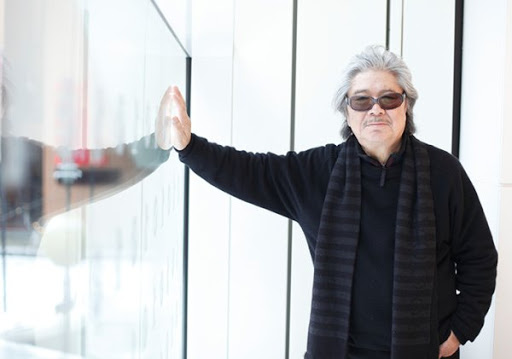
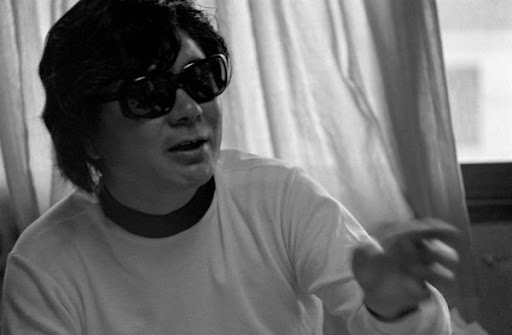
At its peak in the 1960s the brand of kinky soft-core erotica known as pinku eiga, or pink film, accounted for half of all movie production in Japan. Most pink-film directors were anonymous journeymen, but the industry nurtured its share of eccentric talents. Among the most talented and eccentric was Koji Wakamatsu, a gonzo auteur with a knack for eyebrow-raising titles (“Go, Go Second Time Virgin,” “Violated Women in White”) whose most interesting films owe as much to Karl Marx as to the Marquis de Sade.

Like many exploitation filmmakers Mr. Wakamatsu kept up a furious rate of production for much of his career. (He has about 100 movies to his credit and was also an executive producer of “In the Realm of the Senses,” the 1976 succès de scandale directed by his friend Nagisa Oshima.) At 72, having outgrown the smut-minded confines of the pink film, he has made his most ambitious work, “United Red Army,” a 190-minute chronicle of the tumultuous rise and self-destructive collapse of the Japanese militant student groups of the 1960s and ’70s. An intensively researched docudrama, teeming with dates, names and events, it is also a personal reckoning with a familiar narrative of idealism and disappointment: Mr. Wakamatsu and his regular screenwriter in the 1960s, Masao Adachi, were active members of the radical left.

The film is set to receive its United States premiere on July 6 at the Japan Society in New York (where it is being presented by the New York Asian Film Festival and the Japan Cuts festival). Masayuki Kakegawa, who wrote the film with Mr. Wakamatsu, will introduce the screening, after which Mr. Wakamatsu, who has been unable to obtain a United States visa because of his political affiliations, will answer questions by video hookup from Tokyo.


koji wakamatsu- united red army

A former construction worker and gang member (who did some jail time for robbery), Mr. Wakamatsu stood apart from many of his peers by combining rough sex with avant-garde shock tactics and some semblance of New Left politics. In 1965 he put pinku eiga on the international map when his peeping-tom skin flick, “Secrets Behind the Wall,” was invited to the Berlin International Film Festival, much to the horror of the Japanese film establishment. (One sex scene involves a Hiroshima victim and a poster of Stalin.)

Mr. Wakamatsu was back at Berlin this year for a mini-retrospective in the festival’s Forum sidebar, where “United Red Army” screened alongside “Go, Go Second Time Virgin” (1969) and “Ecstasy of the Angels” (1972), an account of a radical cell’s implosion with an abundance of agitprop pillow talk, and an obvious predecessor of the latest film.

Like Philippe Garrel’s “Regular Lovers” (2005), another epically sad post-’68 portrait, “United Red Army” opens on a note of exhilaration before lingering on the painful hangover after the thwarted revolutionary moment. Much of the first hour is devoted to a breathless summary of the decade’s radicalizing events, beginning with the 1960 signing of the United States-Japan Mutual Security Treaty (the target of widespread opposition and the subject of Mr. Oshima’s “Night and Fog in Japan”).


koji wakamatsu- united red army

The Vietnam War was a catalyst, as it was with all student movements of the period, and the American military presence in Japan fueled the fire. By 1968 violent clashes between protesters and riot police were commonplace. Striking students shut down Tokyo University. A demonstration escalated into bloody chaos at Shinjuku Station.

The events are recounted primarily through a vivid collage of archival news footage, set to a rousing rock score by Jim O’Rourke. Drama gradually takes over from documentary as Mr. Wakamatsu introduces his characters, outlining the internal schisms and external forces that caused the student groups to unravel and splinter into extremist factions. After this whirlwind history lesson, which culminates with the merger of two depleted ultra-left brigades into the United Red Army, the film becomes a harrowing chamber piece.

Working with tiny budgets and minimal locations, Mr. Wakamatsu has long made a virtue of claustrophobia. One of his most notorious movies, “The Embryo Hunts in Secret” (1966), is a study of a sadomasochistic encounter that never leaves the sadist’s cramped apartment. “Go, Go Second Time Virgin,” about the relationship between two teenage victims of sexual abuse, unfolds on a high-rise rooftop, an open space made to feel like a no-exit purgatory.

In the purposefully grueling middle section of “United Red Army,” with the ragtag group holed up in a rural cabin, commanders start to behave like cult leaders. For all the talk of “world revolutionary war,” their orders are motivated by power-grabbing paranoia and petty spite. The Maoist practice of self-criticism takes on lunatic dimensions: members perceived as ideologically weak are shamed and beaten unconscious in the hopes they will be “reborn” with a new revolutionary awareness.


koji wakamatsu- united red army

In its final hour the film turns into a tense action thriller as Mr. Wakamatsu restages the part of the story most familiar to Japanese audiences. With their comrades dead or arrested, the five remaining Red Army members escape to a mountain lodge, where they hold a caretaker hostage and face off with the police. (Much of the siege, which lasted 10 days in February 1972, was broadcast on Japanese television.)

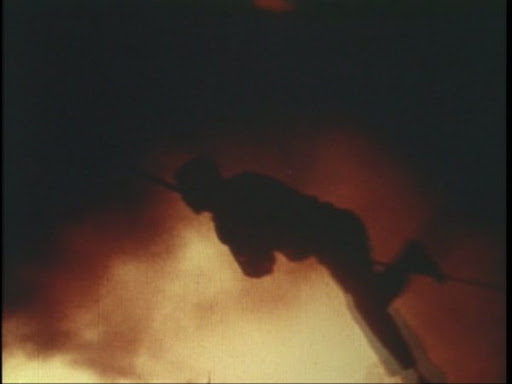
Mr. Wakamatsu, who shot this sequence in his country house, which he went so far as to destroy for the wrecking-ball finale, has said he intended to refute a previous depiction of the incident. “The Choice of Hercules,” a big-budget 2002 film, relates the event from the perspective of the police. In “United Red Army” the policemen remain invisible.

Mr. Wakamatsu underscores the tragic failures of his characters without trivializing their urgent desire for change. The film’s opening image, of students trudging single file through the snow, is accompanied by an on-screen title at once mournful and proud: “Once, armed youth cried out for revolution.”

One of the last lines of dialogue, blurted by a chastened radical, has quite the opposite effect. “We had no courage,” he sobs. Both literally and metaphorically “United Red Army” is a movie that transpires between these two statements, in the chasm between fervent hope and cruel reality.


koji wakamatsu- united red army

Technical Information:

Title: 実録・連合赤軍 あさま山荘への道程/United Red Army
Year: 2007
Country: Japan
Director: Koji Wakamatsu

Source: DVD9 Retail
DVD Format: NTSC
Container: .iso + mds
Size: 7.58 GB
Length: 3:10:02
Programs used: SubMagic, DVD Decrypter, Subtitle Creator, Muxman, VobBlanker, IFOEdit, DVD SubEdit, DVDshrink, ImgBurn

Resolution: 720x480
Aspect Ratio: 16:9
Video: MPEG2 @ ~5200 kb/s
Frame Rate: 29.97 fps

Audio: Japanese- Dolby AC3 Stereo @ 192 kb/s
Subtitles: English (custom)

Menu: Yes
Video: Untouched
DVD Extras: Trailer


Special thanks to Derbalmer and Tadanobu at KG and evildee at ADC for the custom subs and to evildee for the original upload!


koji wakamatsu- united red army

(Use JDownloader to automate downloading)

United Red Army Megaupload Links


Somebody Got Murdered! Week: Koji Wakamatsu- 犯された白衣/Violated Angels (1967)- DVD5 (PAL Format)

koji wakamatsu- violated angels
Violated Angels is the first Wakamatsu film I've had the pleasure of seeing, and seeing as though it's akin to getting hit over the head with a 2x4, I intend to see (and post) as many films of his as I can find.

Violated Angels is weird...hauntingly weird. The readmore can do more justice to the film than me anything I can blabber about, but I will tell you it's based on the Richard Speck murders of the Filipino nursing students in Chicago in 1966. Wakamatsu's approach to this film harkens back to traditional Japanese theater...on acid. The main character (the murderer) has his share of psychic breaks throughout the film, but I don't know who is stranger: him or "the Conch". My pick would be "the Conch".

This is an extremely tough find (custom English subs by Polifem at ADC), so I'm not getting into your business, but this is a MUST download...that is, if you're into Japanese cinema.

P.S.: This is not Pinku. Violated Angels a work of art by a master director.


koji wakamatsu- violated angels

From Nick Rucka at Subway Cinema News:

Divisive, exploitative, cruel, vengeful, erotic, political, provocative, avant-garde — Koji Wakamatsu is all these things, and a ridiculous amount more. A country bumpkin who wandered his way through the Yakuza and into one of the most prolific directing careers in Japan, Wakamatsu has created an unsurpassed, massive filmography of unique and disobedient works. While inextricably connected to the pinku eiga (Japanese soft-core film), Wakamatsu himself has always insisted that his films were something more. Certainly they contain copious amounts of sex and nudity, but this often was a cover for leftist political diatribes decrying Japan’s imperial inclinations, and its subservience to US foreign affairs on Asian politics. Now in his seventies and having produced more than 200 films in his career, Wakamatsu and his uncompromising worldview show no signs of slowing.


koji wakamatsu- violated angels

[...]One of Koji Wakamatsu’s more infamous productions (and inspired by the real-life case of Richard Speck’s 1960s student nurse killing spree in Chicago,) Violated Angels is a compact celluloid acid trip into one man’s derangement as he kills a group of nurses and regresses to a child-like state. Acting more as a protest piece than Grand Guignol debauchery — although it strongly delivers the goods in that department, with shocking deaths filmed in lurid color by Hideo Ito (In The Realm of the Senses), and a bevy of ravaged beauties — the film draws a strong analogy between the man’s dehumanized actions and the Vietnam War protest movement going on concurrently with its production in 1967. Filmed Corman-style in less than one week in order to seize upon the wave of publicity wafting off of the Speck murders, this melancholy mini-masterpiece plunges the viewer headlong into ice-cold madness.


koji wakamatsu- violated angels

Technical Information:

Title: 犯された白衣/Violated Angels
Year: 1967
Country: Japan
Director: Koji Wakamatsu

Source: DVD5 Retail
DVD Format: PAL
Container: .iso + mds
Size: 3.01 GB
Length: 0:56:31
Programs used: SubRip, Subtitles Workshop, Maestro, PgcDemux, Muxman, VobBlanker, DvdSubEdit

Resolution: 720x576
Aspect Ratio: 2.35:1
Video: MPEG2 @ ~6800 kb/s
Frame Rate: 25 fps

Audio: Japanese- Dolby AC3 Stereo @ 192 kb/s
Subtitles: French, English (custom)

Menu: Yes
Video: Untouched
DVD Extras: Preface by Marina de Van (in French)


koji wakamatsu- violated angels

(Use JDownloader to automate downloading)

Violated Angels Megaupload Links