.:[Double Click To][Close]:.

Online CPM Advertising | Advertising blog
Showing posts with label zhang yimou. Show all posts

"What Happened to You, Zhang Yimou?": Zhang Yimou- 活着/To Live (1994)- DVD9 (NTSC Format)

zhang yimou- to live
Pretty safe to say that this is Zhang Yimou's masterpiece, although Raise the Red Lantern will always be my personal favorite. Both Ge You and Gong Li are amazing in this epic film about a family's struggle to live through the Maoist regime. The only word that can describe Gong Li's acting prowess in this film is sublime. This is why we're posting these films- so that viewers so dumbed-down by westernized mediocrity can be exposed to Yimou's practically hidden masterworks that pre-dated the shit he's been pumping out lately. What happened to you, Zhang Yimou? What the hell happened?

Sorry, but this guy pisses me off to no end. I'll get off my soap-box now. Enjoy the film.

zhang yimou- to live

From Caryn James at the New York Times:

In the gambling house where Fugui (Ge You) spends his nights, letting his family fortune slip from his grasp, he is treated like a young prince. The setting is China in the prerevolutionary 1940's, and after hours of gambling, Fugui is carried home at dawn through the streets of his small town on the back of a man who deposits him at his extravagant house. Fugui's wife, Jiazhen (Gong Li), begs him to stop gambling, for the sake of their small daughter and the child she is carrying.

Of course, he doesn't, and soon loses the family home to a bounder called Long Er. One of many great comic ironies in "To Live," Zhang Yimou's family melodrama that sweeps through 30 years of Chinese history, is that this misfortune turns out to be a major piece of luck. When the revolution comes, the house is burned by the Communists and the landowning Long Er is executed. There, but for the grace of his gambling, goes Fugui.


zhang yimou- to live

"Your family's timber was first-rate," a good Communist tells him, describing how fast the house went up in flames. By then Fugui has developed a sense of survival that is by turns funny and heartbreaking and that expresses the very soul of this tragicomic film. "That wasn't my family's timber," he says. "That was counterrevolutionary timber."

"To Live" is purposefully more sentimental than anything Mr. Zhang has done before. After Fugui has lost the house, he takes over a traveling shadow puppet show. While he and his friend Chungsheng are on the road with their theater, they are captured by the losing Nationalist army. When Fugui returns to his much-changed town, he finds that Jiazhen earns a living by delivering water door to door. An illness has left their daughter, Fengxia, deaf. And their son, Youqing, is a spirited boy who becomes the victim of his father's desperate need to disguise his past as a wealthy man.


zhang yimou- to live

This film is also less sumptuously photographed than Mr. Zhang's other works; in the lives of these characters, touches of red on a gray uniform have to pass for glamour. Depicting the characters responding to Mao's changes, "To Live" brings to mind Chen Kaige's "Farewell, My Concubine," though set among poor townspeople rather than against the rich backdrop of the Beijing Opera. In its emphasis on individuals, "To Live" has less in common with Mr. Zhang's earlier, less dramatic films, "Red Sorghum" and "Ju Dou," than with his recent ones, the glorious soap opera "Raise the Red Lantern" and the comic tale of a rebellious woman, "The Story of Qiu Ju." (All of them starring Gong Li.)

But the masterly Mr. Zhang knows he's creating melodrama and exaggerates to profound effect. The family tragedies in "To Live" demonstrate how China's politics scarred individuals who were treated as pawns in Mao's progress, and its sentimentality shows that ideology is no comfort in the face of personal anguish. In two magnificent performances, Gong Li carries the story's emotions and Ge You the weight of history. Gong Li is, as always, a powerful heroine. But Mr. Ge is a revelation, evoking sympathy and pity as a man whose weakness causes him to bend like a reed in the changing winds of Chinese politics and whose strength allows him to endure the consequences.


zhang yimou- to live

During the Great Leap Forward in the 1950's (the historical changes are explained clearly in succinct titles through the film), the entire town donates all metal objects to support steel production. Even the family's pans are taken away, and everyone eats at the communal kitchen. That is where the mischievous Youqing pours a huge amount of chili sauce on a big bowl of noodles, then calmly dumps it on the head of a boy who has been taunting his sister. For that, Fugui publicly spanks his son, agreeing that the little boy's gesture was a counterrevolutionary act meant to undermine the communal kitchen.

Irreverent though Mr. Zhang's take on Chinese history is, "To Live" is primarily a story of living with sadness. Fugui's old friend Chungsheng becomes a district leader and accidentally causes a death. "You owe us a life," Jiazhen screams at him, and the line becomes a refrain that resonates through the film.


zhang yimou- to live

In the 60's, during the Cultural Revolution, Fugui and Jiazhen hear that their prospective son-in-law, a committed Maoist, is tearing their house apart. They race home only to find him helpfully repairing the roof and painting huge murals of Mao on the walls. Throughout, Mr. Zhang creates an inescapable sense of the tension and fear that informs the characters' daily lives.

The Communist revolution is increasingly blamed for the family's tragedies. When someone dies because the reactionary doctors have been taken away from the hospital, leaving only inept students behind, there is no mistaking the political toughness of this melodrama's message.

This film has created serious problems for Mr. Zhang. The Chinese Government was unhappy that "To Live" was entered in competition at this year's Cannes Film Festival, where Gong Li and Ge You were present and won best acting awards. In the last few weeks, the Government has stopped production on Mr. Zhang's new movie, partly financed with French money, and barred him from working on foreign co-productions.


zhang yimou- to live

Technical Information:

Title: 活着/Huózhe/To Live
Year: 1994
Country: China
Director: Zhang Yimou

Source: Retail DVD9
DVD Format: NTSC
Container: .iso + mds
Size: 6.97 GB
Length: 2:12:26
Programs used: ImgBurn

Resolution: 720x480
Aspect Ratio: 1.85:1
Video: MPEG2 @ ~6800 kb/s
Frame Rate: 29.97 fps

Audio: 简体中文/Mandarin- Dolby AC3 Stereo at 192 kb/s
Subtitles: English, French, Spanish

Menu: Yes
Video: Untouched
DVD Extras: Theatrical trailer


zhang yimou- to live

(Use JDownloader to speed up downloading and avoid file stalls.)

活着 Megaupload Links


"What Happened to You, Zhang Yimou?": Zhang Yimou- 秋菊打官司/The Story of Qiu Ju (1992)- DVD5 (NTSC Format)

zhang yimou- the story of qiu ju
The Story of Qiu Ju, along with Raise the Red Lantern, are personal favorites of mine. This film shows that Gong Li is not just a pretty face and that she has wonderful comedic talent. Qui Ju's one-woman mission to find justice for her husband in a fractured system allows Gong Li to shine. It's interesting that in most of Zhang Yimou's films, there are more Gong Li close-up's than you can shake a stick at. In The Story of Qiu Ju there is only one, but it's one of the most powerful close-ups you'll ever experience. The quality of this print, unlike Red Sorghum, is excellent, so you won't be disappointed if you're a Yimou/Gong Li fan.

Professor Jack Ass asked "What the hell happened to The Story of Qiu Ju?" Nothing happened. We simply took our time. To Live is up next, unless we die. Enjoy the film!


zhang yimou- the story of qiu ju

From Roger Ebert:

"The Story of Qiu Ju" begins with a shot of a Chinese city scene, the streets teeming with people, most of them on foot or bicycle. Eventually the camera isolates three of them: A man sprawled uncomfortably on a cart, and two women who are pushing him. One of the women is pregnant. After they arrive at a doctor's office, she explains that her husband has been kicked in the groin by their village political leader.

The doctor is not the sort to inspire confidence. He advises rest. Soon the women - sisters - are making the journey back home again, pulling the cart through cold winter weather to their village.

The husband is inclined to take his fate philosophically, and wait for his pain to subside. Not Qui Ju, the wife. "If we can't fix your plumbing, we may be stuck with the single-child policy," she laments.

She wants to see justice done.


zhang yimou- the story of qiu ju

So begins the story of two very stubborn people, Qui Ju and the political head, played by Lei Lao Sheng. Qui Ju is played by Gong Li, the most famous Chinese actress, and the movie is directed by Zhang Yimou, the most successful of the "fifth generation" of Chinese directors. Gong has starred in all of his films: "Red Sorghum," "Ju Dou," "Raise the Red Lantern." Even in the gritty worlds of the first two films, she looked beautiful, and in the third she was glamorous. But here, in Zhang's first film set in present-day China, she looks worn, tired, and very pregnant.

She goes to the local police chief, demanding that the political leader apologize to her husband and make financial reparations. The policeman works out a compromise, but then the leader throws the money contemptuously at her feet. So she refuses the payment, and sets off to appeal the case to a regional leader.

She will spend much of the movie on foot and in crowded trains, appealing to higher and higher authorities, as the film essentially follows her through a vertical cross-section of modern China.

At first, to be sure, we are not quite certain what the film's period is. In Qui Ju's village, life continues as it has for many years, and it is a little shock to see the first automobile in the movie; we could almost think ourselves in an earlier century. Qui Ju is also from an earlier time, and when she visits the regional capital she is quickly conned by a dishonest cabdriver.


zhang yimou- the story of qiu ju

The movie is a departure for Zhang, whose "Raise the Red Lantern" was shot almost entirely inside an elaborate set representing a rich man's house. This time, his famous star disguised by drab clothes and a well-developed pregnancy, he shoots on city streets with a concealed camera. One of the pleasures of the film is to see everyday China, which appears on screen unrehearsed and natural. Only three of the movie's actors are professionals, and the others essentially play themselves.

The movie's style and narrative seem inspired by postwar Italian neorealism, which attempted to tell the stories of ordinary people with ordinary problems. Qui Ju stubbornly sets off on one journey after another, appealing to district police chiefs, regional political leaders and finally even to the courts. All the authorities agree that she has a case. They keep suggesting the same remedies: A fine for the village leader, and an apology. But the leader's pride will not allow him to seem humbled before a woman (the husband and his aggrieved loins are by now reduced to bystander status).


zhang yimou- the story of qiu ju

There is a point in the film when it begins to seem repetitive: The leader will remain unbending, the Qui Ju will keep appealing. Then we begin to connect with the underlying story of the film, which is about the rhythm of village life, the relationships of friend and family, and the approaching birth of Qui Ju's child. It is also interesting to note her style of conduct. She is angry, but she often quite subdued in her confrontations; her strategy involves tenacity rather than pyrotechnics.

If a similar story were set in America, it would probably be made more obviously funny, and star someone famous for pluck - Sally Field, for example. Zhang's approach is more understated. Watching the film, we find the humor for ourselves, and along the way we absorb more information about the lives of ordinary people in everyday China than in any other film I've seen.


zhang yimou- the story of qiu ju

Technical Information:

Title: 秋菊打官司/The Story of Qiu Ju
Year: 1992
Country: China
Director: Zhang Yimou

Source: Retail DVD5
DVD Format: NTSC
Container: .iso + mds
Size: 4.19 GB
Length: 0:59:35
Programs used: ImgBurn

Resolution: 720x480
Aspect Ratio: 16:9
Video: MPEG2 @ ~5800 kb/s
Frame Rate: 29.97 fps

Audio: Chinese- Dolby AC3 Stereo @ 192 kb/s
Subtitles: English

Menu: Yes
Video: Untouched
DVD Extras: None


zhang yimou- the story of qiu ju

(Use JDownloader to speed up downloading and avoid file stalls.)

秋菊打官司 Megaupload Links


"What Happened to You, Zhang Yimou?": Zhang Yimou- 红高粱/Red Sorghum (1987)- DVD5 (PAL Format)

zhang yimou- red sorghum
It's almost impossible to believe that the only source of Red Sorghum is this analogue to DVD HK version of the film, but it is. To think that Yimou's freshman outting is being treated this way by the film community is unconscionable. That being said, the reason we're posting this and the rest of Zhang Yimou's films up to Hero's is to remind people how wonderful a master director he was. I said was. Also, if you're a rabid Gong Li slut like me, this is the first time Her Highness was ever put to film. God, isn't she's beautiful? Well?

Enjoy the ratty film, because that's all there is. More Yimou on the way. I believe that the Story of Qiu Ju is next up.


zhang yimou- red sorghum

From David Neo at Senses of Cinema:

My thinking about culture begins the moment it is in ruins.

– Chen Kaige

Zhang Yimou has been hailed as the most creative and outstanding filmmaker of the Fifth Generation. Zhang and his compatriot Fifth Generation filmmakers (such as Chen Kaige and Tian Zhuangzhuang) were the first post-Cultural Revolution graduates from the Beijing Film Academy (graduating in 1982 this class was labelled the Fifth Generation). They were largely responsible for bringing international recognition to Mainland Chinese films. Prior to the emergence of the Fifth Generation, Chinese cinema was dominated by the production of propagandist films. The Fifth Generation filmmakers challenged the existing system both indirectly and directly; in order to evade censorship, these directors employed the clever use of allegory, symbol and metaphor. In so doing, the Fifth Generation filmmakers have been applauded for their hauntingly beautiful, culturally rich and multi-layered cinematographical language.

Red Sorghum made in 1987 was the first film that Zhang directed. His second film Ju Dou (1990) won numerous prestigious international awards such as the 1990 Golden Bear Award at the Berlin Film Festival, the Golden Hugo Award at the Chicago International Film Festival and Best Film at the 1990 New York Film Festival. Ju Dou was also the first Chinese film to be nominated for Best Foreign Language Film, at the 1990 Academy Awards. Zhang’s third film, Raise the Red Lantern (1991) won five prizes at the 1991 Venice Film Festival, and was also nominated for Best Foreign Film at the 1992 Academy Awards.

zhang yimou- red sorghum

Paul Clark, a scholar on Chinese film, writes that the images of China in Fifth Generation films “reflect a profoundly ambivalent nationalism”. This is understandable considering the historical and cultural milieu from which the Fifth Generation filmmakers emerged. This profoundly ambivalent nationalism manifested itself in many of their films including Red Sorghum. Red Sorghum can be aptly described as a film involved in a deep questioning and searching for roots. The film’s concentrated focus on folk culture tells a story – or even a “legend”, as the film itself suggests – of the narrator’s grandparents. The narrator’s obvious Chinese background but anonymous identity seems to imply and encourage a universal, grass roots questioning of the Chinese heritage. The narrator is, in fact, not even sure of who his grandfather is, nevertheless, he likes to believe that it is the character of Grandpa (Jiang Wen), who was one of Jiu’er or Grandma’s (Gong Li) bridal sedan-bearers. Inherent in how this story or legend is constructed is a deep questioning of China’s roots – who and how did our (Chinese) ancestors come about? This questioning of China’s roots and origins is also illustrated in the metaphor of the sorghum – how did the sorghum come to grow in this area (the Northeast of China)? The narrator tells us that no one knows and that it simply grew wildly and naturally. The film’s focus on folk culture repudiates or questions the refined and sophisticated notions of Chinese culture; awakening us to more primal instincts.

Red Sorghum‘s return to grass roots seems to also be a celebration of the carnal. The film invokes many ideas of Russian philosopher Mikhail Bakhtin’s notion of the carnival; essentially a return to basic biological needs such as eating, drinking, defecating, making love and rearing children. From the start of the film, the body and bodily functions are depicted in the unabashed shots of the sedan-bearers’ naked, sweat-soaked and dust-covered torsos as they teasingly, but vigorously, jostle the bridal palanquin. And throughout the film, the men are shown in various states of undress in their labours; for example, in the wine-brewing scene, the men are only clad in loin-cloths, and are warned of Jiu’er’s approaching presence, and hence are being called to appropriately cover themselves. The scenes of the invocation of the wine god succinctly encapsulate the celebration of the carnal as the characters of the film overtly evoke the Nietzschean celebration of the Dionysian spirit. The semi-nude men displaying their raw masculinity get drunk in the worship of the wine god and chant:

If you drink our wine,
You’ll breathe well and you won’t cough;
If you drink our wine,
You’ll be well and your mouth won’t smell bad…
If you drink our wine,
You won’t kow-tow to the emperor…


zhang yimou- red sorghum

But the crudest example of the celebration of the carnal would be Grandpa pissing into the wine vats; which curiously produces the best wine the winery has ever made. It clearly exemplifies Grandpa’s virility. The raw masculinity portrayed in Red Sorghum is a sharp contrast to the traditional (even effeminate) Chinese image of the refined, cultivated and intellectual man that is very much associated with the Imperial Examinations of the feudal system of China. Red Sorghum promulgates a search for roots deeper and more genuine than those of traditional imperial China, as the chant defiantly resonates: “If you drink our wine, you won’t kow-tow to the emperor!”

This sharp attack on traditions is not only seen in the seemingly ludic chant above; but more poignantly in the allegory of the leprous winery owner, who represents China’s obsolete feudal and patriarchal system – which is depicted as impotent and ineffective. The acerbic criticism is made when we find out that Jiu’er is forced into marriage to a leprous winery owner in exchange for a mule – Jiu’er daringly questions her father’s love and even denounces him for such a cruel and callous act. Refusing to be subjected to her ill fate, Jiu’er is only armed with a pair of scissors to guard her dignity; fortunately, the consummation of the marriage never occurs and the leprous winery owner mysteriously dies. The narrator believes that Grandpa is responsible for the death. Jiu’er instead gives herself to Grandpa, who carries her off into the sorghum field and makes a bed out of wild sorghum for her – this is where the narrator’s father is believed to have been conceived. The film blatantly criticises the ineffectual and repressive feudal and patriarchal system of China, boldly awakening and beckoning us to the real and genuine realities of our feelings and primal instincts.


zhang yimou- red sorghum

The search for roots can also be seen in the landscape represented in the film. Previously, Chinese filmmakers have represented China through the quintessentially southern landscape of water, trees, cultivated fields and cosy settlement. Red Sorghum, however, defies this tradition and is set in the rough northeast Gaomi Township, where Mo Yan, the author of the novel Red Sorghum, comes from. Contrastingly different from the south, Mo Yan describes the northeast as “the most beautiful and repulsive, most unusual and most common, most sacred and most corrupt, most heroic and most bastardly, hardest-drinking and hardest-loving place in the world…”

Zhang has purposefully chosen this harsh environment for the film, challenging the traditional outlook and established notions of China’s roots. One of the most memorable images in Red Sorghum is found in the last sequence of the film, where we see the mud-caked half-naked bodies of Grandpa and the narrator’s father amongst the corpses. After plotting an ambush and eradicating the Japanese troops, Grandpa and his son (the father of the narrator) are the sole survivors at the end of the film – both these characters’ actual names are never revealed and we are introduced to them simply, almost generically as the nameless narrator’s father and Grandpa, symbolic representations of the Chinese people. The closing images of mud-covered naked bodies and swaying wild sorghum – with folk songs sung as tributes to Jiu’er and the primal beating of the drum – tell us that the characters’ survival and the survival of the Chinese people depend on their ability to shake off the shackles of repression of Chinese culture and return to grass roots.


zhang yimou- red sorghum

Technical Information:

Title: 红高粱/Red Sorghum
Year: 1987
Country: China
Director: Zhang Yimou

Source: DVD5 Retail
DVD Format: PAL
Container: .iso + mds
Size: 3.79 GB
Length: 1:28:10
Programs used: ImgBurn

Resolution: 270x576
Aspect Ratio: 16:9 Letterboxed
Video: MPEG2 @ ~5800 kb/s
Frame Rate: 25 fps

Audio: Mandarin- Dolby AC3 Stereo @ 192 kb/s
Subtitles: English

Menu: Yes
Video: Untouched
DVD Extras: None


zhang yimou- red sorghum

(Use JDownloader to speed up downloading and avoid file stalls.)

红高粱 Megaupload Links


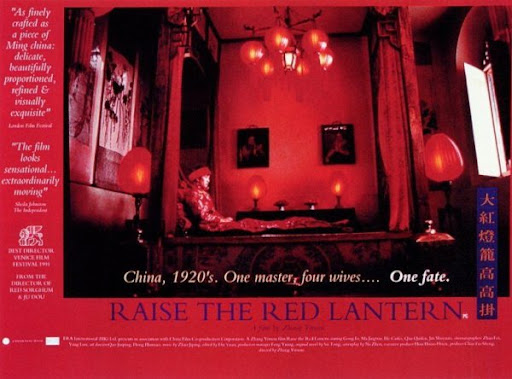
Zhang Yimou- 大红灯笼高高挂/Raise the Red Lantern (1991)- DVD9 (NTSC Format)

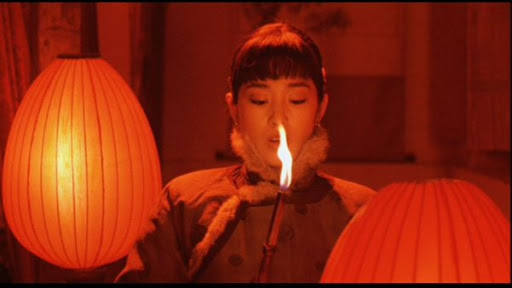
zhang yimou- raise the red lantern
Let me tell you a Zhang Yimou story...

L&S and I went to see a film lecture on Crouching Hero, Flying Dagger, and after the film there was a Q&A section with the film professor who hosted the event. The rest of the story isn't pretty. It involved me going on a rant about how low Zhang Yimou had sunk to be making movies as horrid as what I had just sat through, and how he'd gone "Hollywood". Then the professor informed me (as if I didn't already know) that Crouching Dagger, Flying House wasn't a Hollywood film...it was Chinese.

Then I went on a rant about how the horrid actress in the horrid film "was no Gong Li", but the professor didn't budge. He said that Crouching Hero, Hidden Dagger was a progression for the director, and then went on to say that "as Van Gogh painted with the colors of madness, Zhang Yimou painted with the colors of the seasons". Bullshit. Pure and utter bullshit.

Dear Lord...that movie sucked donkey dicks. The actors couldn't act their way out of a bag, and the story was boring. Beautiful colors and scenery do not make a great film.

So to prove to that jack-ass of a film professor, I'm going to be posting a calvalcade of Zhang Yimou films mostly long forgotten that are true masterpieces of cinema...and they'll all have Gong Li in them, not some two-bit impostor with no acting ability. To start off, here's Raise the Red Lantern. This film is beautiful, but it's also superbly acted and has a gripping story to back it up. We almost called this ongoing tribute "Remember When Zhang Yimou hadn't Sold His Soul?", but that would have been much too harsh...I think. Enjoy some classic Yimou with his muse, Gong Li.


zhang yimou- raise the red lantern

From David Neo at Senses of Cinema:

Only when things are investigated is knowledge extended; only when knowledge is extended are thoughts sincere; only when thoughts are sincere are minds rectified; only when minds are rectified are the characters of persons cultivated; only when characters are cultivated are families regulated; only when families are regulated are states well governed; only when states are well governed is there peace in the world.

– Confucius (551–479 B.C.)

Confucianism formed the basis of Chinese culture when the Han Emperor Wu, who ruled China from 140 to 87 B.C., instituted it as state ideology and orthodoxy. Zhang Yimou’s fourth film, Raise the Red Lantern, is the last of a trilogy (Red Sorghum [1987] and Judou [1990] are earlier instalments) that is deeply critical of Confucianism and Chinese culture. The film was banned in its home country and never made it to the silver screen in China; after the ban was lifted, it was “marginalised” and only shown on television.


zhang yimou- raise the red lantern

According to Sheldon Lu, the Fifth Generation filmmakers (such as Chen Kaige, Tian Zhuangzhuang and Zhang) were part of a nationwide intellectual movement that swept China in the mid- and late 1980s, and embarked on a cultural critique of the deep structure of the Chinese nation: “their (the Fifth Generation filmmakers’) frequent deployment of long takes, long shots, and deep focus, are anguished, self-reflexive, slow-paced, scathing critiques of entrenched patterns of traditional Chinese culture”. Raise the Red Lantern portrays life in a stifling and constrictive sanheyuan or Chinese courtyard house (which usually belong to families established for many generations). The family institution is central to Chinese culture, as according to Confucian philosophy, it is believed that only when families are well run, will the state also be well governed. The sanheyuan was developed in China based on Confucian ideology and epitomises classical Chinese architecture – the way in which space is outlined and occupied in these houses is an expression of the complex social rules that are supposed to embody domestic utopia. Sanheyuan(s) were self-contained and everything that one needed could be found within these courtyard houses; doctors and even entertainment were brought into the compound when required; at auspicious occasions, Chinese operas would be staged to entertain the household and guests. The Forbidden City in Beijing was the ultimate sanheyuan.


zhang yimou- raise the red lantern

Women would never venture beyond the enclosing walls of the sanheyuan, as it is supposed to protect them from the hardships of the outside world. Within these high walls, the writing of poetry and the study of Confucian philosophy were supposed to be pursued in celestial peace. But this is certainly not the idyllic setting that we find in Raise the Red Lantern, where infighting is rife and the web of deceit spun by the wives and maids is impenetrable! One of the lasting images that we are introduced to at the beginning of the film is when Songlian enters the sanheyuan in her school uniform. She is symmetrically framed by a huge Chinese plaque behind her, inscribed with archaic Chinese characters gilded in gold – the image is a presentiment of how the rules of the Chen household will eventually swallow her up. Songlian is immediately engaged in the intrigues of the house; when a maid disrespectfully acknowledges her as the “new” Fourth Mistress, our protagonist quickly foils the maid’s disrespect by responding, “yes, and you can bring my luggage in!”

Joann Lee analyses the film through what she calls the “Confucian/feminist matrix”. This “matrix” is indeed complex in Raise the Red Lantern. Ideally, the sanheyuan is supposed to protect the women from the hardships of the outside world, but ironically in Raise the Red Lantern the hardships found within its high walls are perhaps even more virulent! Quite the contrary to the pursuit of poetry and learning in the utopian celestial peace supposedly offered by the sanctuary of the sanheyuan, we witness the events of what is essentially a “domestic bordello” – where the wives ruthlessly fight for the lighting of red lanterns in their quarters, so that the master will spend the night with them, and they will subsequently receive the privilege of exotic foot massages. Throughout the film, Zhang demonstrates the “confusion ethics” that run amok within a sanheyuan!


zhang yimou- raise the red lantern

The Confucian/feminist “matrix” employed by Zhang poignantly highlights the ineffectualness and oppressiveness of the Chinese Confucian system. Confucianism fosters a patriarchal society through its emphasis on rigid class and gender lines, customs, ancestral worship and heavy priority placed on having a male heir to continue the family name. Daughters are not valued, as seen in Raise the Red Lantern, but treated as objects. They are not free to make major choices in life such as choosing their own life partner in a marriage; instead, marriages are often dictated by economic gains. Women have no identity apart from men, they are there simply to satisfy the male sexual appetite and provide a male heir, as we see in Raise the Red Lantern. Chinese women are imbibed to obey their fathers as children; obey their husbands when married; and follow their eldest sons when widowed. Therefore, when women gain their identity and stations in life from this oppressive structure, they in turn, gain satisfaction from enforcing these customs and rules on less powerful women. This is artfully portrayed in Raise the Red Lantern – having received more education compared to the other wives in the Chen household, we expect Songlian to be above the deceit of the wives and maids, but she becomes entrapped in household intrigues and is later instrumental in her maid’s death and the execution of the Third Mistress.

Fetishes are replete in Raise the Red Lantern. The foot massage stands out not only thematically and psychologically, but also culturally. Thematically, the foot massage is a symbol of power – it is a privilege enjoyed by the woman whom the master chooses to spend the night with. The enticing and haunting beat of tiny pebbles echoes throughout the house each evening as the woman whose soles are being beaten luxuriates in the sensation. She knows the master favours hers and basks in the sense of power and attention. As Second Mistress tells Songlian, “don’t underestimate the foot massage; if you get one everyday, you will be ruling the household!”.


zhang yimou- raise the red lantern

The foot massage is a fetish for both the patriarch and his wives (this fetish acting as a substitute for a woman’s “lack”). The woman is paradoxically the mechanism by which the man achieves phallic wholeness, from and through which he derives pleasure; yet at the same time renouncing it. Fetishism is commonly viewed as being derived from the castration complex, in which the fear of castration is repressed and displaced by fixating on some object; and in the case of Raise the Red Lantern, the foot massage is one form of fetish. The wives, of course, are another form of fetish – the more wives the master has, the greater the affirmation of his maleness. This is perhaps why Third Mistress’ infidelity poses such a threat to this patriarchal system – by having a lover, she assumes the “phallic” power that men enjoy. She is eventually executed, an ultimate form of castration. Confucianism dictates that every person knows his or her place in society, and that upholding family tradition takes precedence over the individual’s needs. In previous generations within the Chen household it was hinted that two women were murdered for cheating on their husbands. Songlian’s flute can also be regarded as a fetish (aside from its phallic shape). The flute in Chinese culture symbolises erudition and only men played the flute. The flute signifies Songlian’s privileged education that is denied the film’s other female characters. She has unwittingly inherited the flute from her father, but it is quickly wrested from her, emasculating her, reducing her to the level of the less educated wives. In Songlian’s own words, the level of animals who senselessly plot against each other!


zhang yimou- raise the red lantern

Historically and culturally in China, the metonymic relationship between a woman’s feet and sexuality is well known. It was a Chinese myth that the smaller a woman’s feet, the smaller her vagina – therefore, the better for the man. Between the 10th and 20th centuries, foot binding was part of the class dynamic. Only “privileged” girls had their feet bound, as it was perceived that the rich could keep their women idle – girls’ toes were turned under the soles of their feet, hence breaking them, and their flesh rotted into blood-soaked bandages. Foot binding also ensured that women would take smaller, daintier steps, attaining a more graceful gait. Zhang ingeniously reinscribes and critiques the Chinese tradition of foot binding by replacing it with the foot massage. The foot massages are seen less as a reward and privilege for women – for it serves the interests of the master or patriarch – than as a kind of foreplay to “prepare” the vagina as a receptacle for the penis. In the master’s words, to help her “better serve” him!

The Confucian/feminist “matrix” is effectively employed by Zhang to illustrate the oppression of the Chinese people, who are choked by their ineffectual “confusion ethics”. The film highlights that Chinese traditions and rituals are in dire need of re-evaluation; there is no investigation of knowledge or cultivation of characters advocated by Confucius – merely an oppressive system of rules. The film focuses on a family, but its fate also extends to a country and civilisation gone awry. The women in Raise the Red Lantern represent the Chinese people who are oppressed by an authoritarian government that allows no freedom of expression – surely the film makes obvious but coded reference to the Tiananmen Square Massacre that occurred in 1989. The many students murdered at the square are represented by the cruel execution of Third Mistress. It is no wonder that Raise the Red Lantern was banned in China when it was released in 1991 and was never screened in cinemas. Ironically, lanterns provide illumination, and therefore, are supposed to enlighten, as does Confucianism. Instead, they represent symbols of oppression in the film; used ritualistically to augment a barbaric system of class and gender exploitation that defines Zhang’s view of Confucianism.


zhang yimou- raise the red lantern

Technical Information:

Title: 大红灯笼高高挂/Dà Hóng Dēnglóng Gāogāo Guà/Raise the Red Lantern
Year: 1991
Country: China
Director: Zhang Yimou

Source: DVD9 Retail
DVD Format: NTSC
Container: .iso + mds
Size: 7.73 GB
Length: 2:04:58
Programs used: ImgBurn

Resolution: 720x480
Aspect Ratio: 16:9
Video: MPEG2 @ ~5800 kb/s
Frame Rate: 29.97 fps

Audio: 简体中文/Mandarin- Dolby AC3 @ 192 kb/s
Subtitles: English, Español, Français

Menu: Yes
Video: Untouched
DVD Extras: None


zhang yimou- raise the red lantern

(Use JDownloader to speed up the downloading of these files. DO NOT download thru your browser unless you like file stalls.)

大红灯笼高高挂 Megaupload Links