.:[Double Click To][Close]:.

Online CPM Advertising | Advertising blog
Showing posts with label suehiro maruo. Show all posts

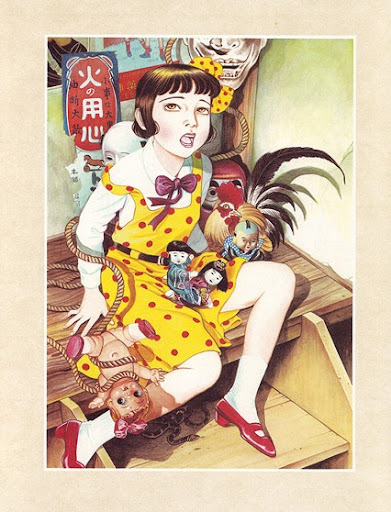
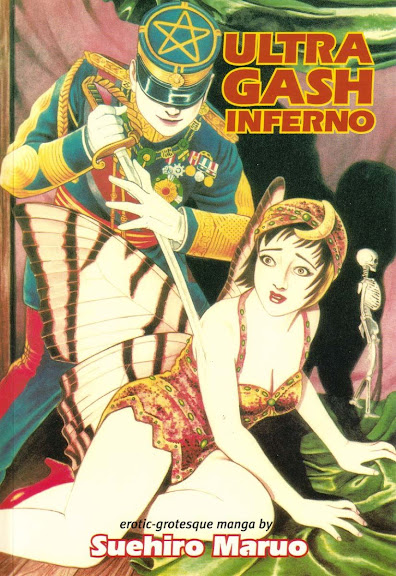
Suehiro Maruo- Ultra-Gash Inferno (2001)- JPG Format

suehiro maruo- ultra gash inferno
I've been lagging on my Suehiro Maruo posts, so for the next few weeks there's a chance that FTD might be inundated with buckets of ero-guro. If you get splattered, I apologize in advance.

suehiro maruo- ultra gash inferno

From Richard J. Hand at M/C Journal:

Given that the new advances in technology in the 1980s had a major impact on the carefully constructed myth of authenticity in horror and pornography, ranging from flawless special effects at one extreme to the idea of the handheld voyeur movie at the other, it is rather ironic that the key progenitor to the erotic-grotesque form is a long-established and in some ways basic form: the pen and paper art of manga. This medium can be traced back to pillow books and the illustrated tradition in Japanese culture – a culture where even written language has evolved from drawings rather than alphabetical ciphers. Technological innovation notwithstanding, the 1980s is an extraordinary period for manga and it is perhaps here that we find the most startling hybridisation of porn and horror where, to borrow a phrase from Liz Kotz, “pathology meets pleasure, where what we most fear is what we most desire”. Many of the most extreme examples of 1980s manga repeatedly confront the reader with tales that intersperse and interlink imagery and narrative sequences of sex, violence and the abject.

suehiro maruo- ultra gash inferno

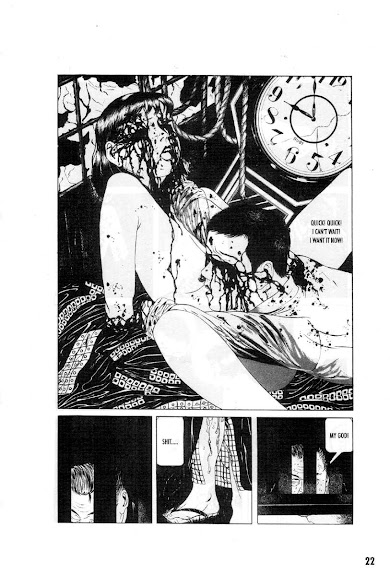
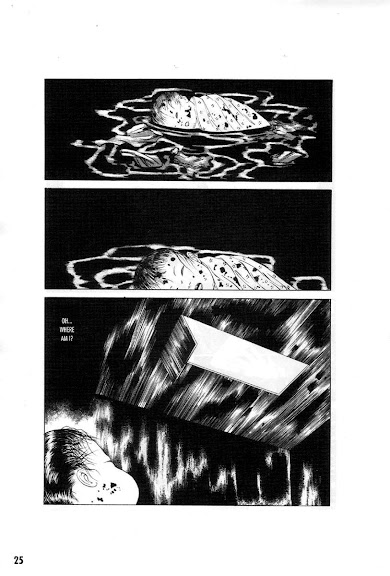
Suehiro Maruo is in many ways a commercially marginalised but highly renowned manga artist of the erotic-grotesque. His full-length manga novel Mr Arashi’s Amazing Freak Show (1984) is a sweeping tale of carnival freaks redolent with sex and sadism, but in this article I will address his short comic strips from around the same period. The stories collected in Suehiro Maruo’s Ultra-Gash Inferno (2001) present a mortifying vision of sex and horror with stories that draw on the erotically tinged world of classical Japanese theatre and the short fiction of Edogawa Rampo but push them into the domain of extreme pornography. In “Putrid Night” (1981), an abusive man, Todoroki, subjects his teenage wife, Sayoko, to vicious cunnilingus and anal sex. In one sequence, Sayoko gives oral sex while Todoroki runs a samurai sword across her cheek. In her misery, Sayoko finds true love in the teenage boy Michio. Their illicit sexual love is tender and fulfilling and yet the imagery that intersperses it is ominous: when they have sex in a field, their conjoined bodies are juxtaposed with rotting fruit infested with ants and Michio’s erect penis is juxtaposed with a serpent in the grass. Sayoko and Michio plot to murder Todoroki. The result is disastrous, with Todoroki cutting off the arms of his wife and her lover through the elbows, and lancing their eyeballs. In the carnage, Todoroki has sex with Sayoko. The young lovers do not die, and Todoroki keeps them alive in a cell as “pets” . In a grotesque triumph of true love, Todoroki, to his horror, spies on his two victims and sees them, their eye sockets and arm stumps pouring blood, tenderly making love.

suehiro maruo- ultra gash inferno

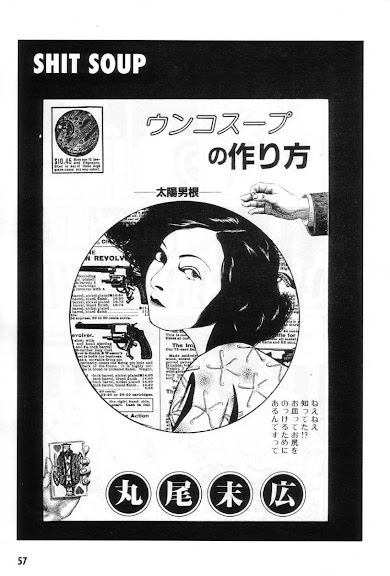
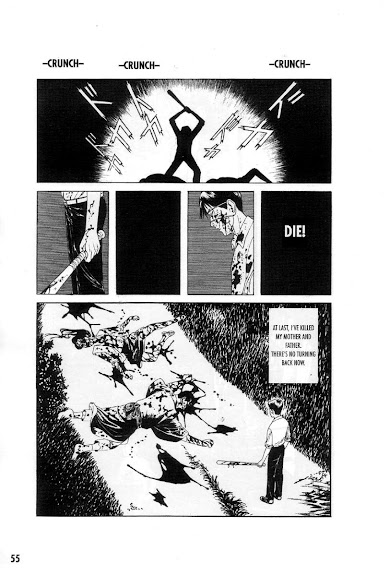
In “Shit Soup” (1982), Maruo produces a comic strip with no story as such and is therefore a highly simplistic pornographic narrative. We witness a menage a trois with a young woman and her two male lovers and the comic presents their various exploits. In their opening bout, the woman squeezes a cow’s eyeball into her vagina and one man sucks it out of her while the other licks her beneath the eyelid. Later, the three excrete onto dinner plates and dine upon their mixed shit. The story ends with the three laughing deliriously as they fall from a cliff, an emblem of their joyful abandon and the intersection of love and death. As epilogue, Maruo describes the taste of excrement and invites us to taste our own. This ending is an ingenious narrative decision, as it turns on the reader and strives to deny us – the viewer/voyeur – any comfortable distance: we are invited, as it were, to eat shit literally and if we refuse, we can eat shit metaphorically. Suehiro Maruo’s work can also be subtle: in what looks like a realistic image at the opening of “A Season in Hell” (1981), a dead teenage girl lies, covered in “gore and faeces”, on a grassy path which resembles the hairy opening to female sexual organs. The surrounding field is like a pudenda and the double arch of the nearby bridge resembles breasts. Maruo can thus outwit the censorship tradition in which pubic hair is generally forbidden (it does appear in some of Maruo’s comic strips), although erections, ejaculations and hairless openings and organs would seem to be always graphically permissible.

suehiro maruo- ultra gash inferno

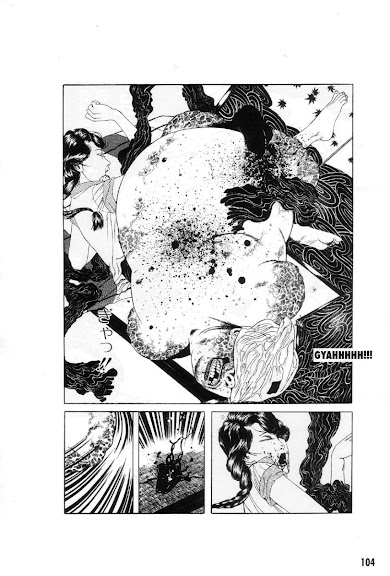
Probably the most excessive vision in Ultra-Gash Inferno is “The Great Masturbator” (1982). In this, Suehiro Maruo presents a family in which the father repeatedly dresses his daughter up as a schoolgirl in order to rape her, even cutting a vagina-sized hole into her abdomen. Eventually, he slices her with numerous openings so that he can penetrate her with his fists as well as his penis. Meanwhile, her brother embarks on an incestuous relationship with his ancient aunt. After her death, he acquires her false teeth and uses them to masturbate. He ejaculates onto her grave, splitting his head open on the tombstone. The excess and debauchery make it a shocking tale, a kind of violent manga reworking of Robert Crumb’s cartoon “The family that lays together, stays together” from Snatch 2 (January 1969). Like Crumb, we could argue that Maruo employs explicit sexual imagery and an ethos of sexual taboo with the same purpose of transgressing and provoking the jargon of particular social norms.

suehiro maruo- ultra gash inferno

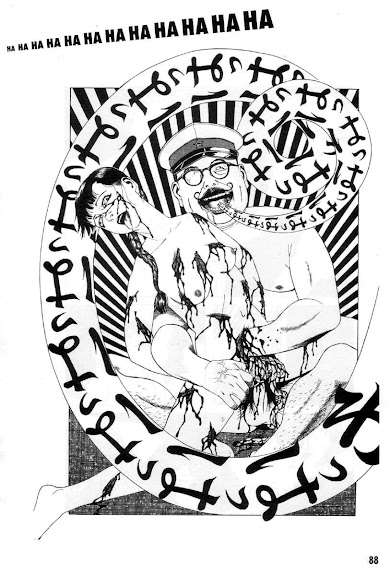
The political dimension to Maruo’s work finds its most blatant treatment in “Planet of the Jap” (1985), anthologised in Comics Underground Japan (1996). This manga strip is a devastating historical-political work presented as a history lesson in which Japan won the Second World War, having dropped atomic bombs on Los Angeles and San Francisco. The comic is full of startling iconic imagery such as the Japanese flag being hoisted over the shell-pocked Statue of Liberty and the public execution of General MacArthur. Of course, this being Maruo, there is a pornographic sequence. In a lengthy and graphic episode, an American mother is raped by Japanese soldiers while her son is murdered. As these horrors are committed, the lyrics of a patriotic song about present-day Japan, written by the Ministry of Education, form the textual narrative. Although the story could be seen as a comment on the subjection of Japan at the end of the Second World War – a sustained ironic inversion of history – it seems more likely to be a condemnation of the phase of Japanese history when, tragically, a minority of “atavistic, chauvinistic, racist warmongers” secured for themselves a position of “ideological legitimacy and power”. However, Maruo is being deliberately provocative to his contemporary reader: he writes this story in the mid-1980s, the peak of Japan’s post-war prosperity. As Joy Hendry says, Japan’s “tremendous economic success” in this period is not just important for Japan but marks an “important element of world history”. Maruo ends “Planet of the Jap” with a haunting international message: “Don’t be fooled. Japan is by no means a defeated nation. Japan is still the strongest country in the world”.

suehiro maruo- ultra gash inferno

The porn-horror creator Suehiro Maruo follows in the tradition of figures like Octave Mirbeau, Georges Bataille and Robert Crumb who have used explicit pornography and sexual taboo as a forum for political provocation. The sexual horror of Maruo’s erotic-grotesque manga may terrify some readers and titillate others. It may even terrify and titillate at the same time in a disturbing fusion which has social and political implications: all the Maruo works in this essay were produced in the early to mid-1980s, the peak of Japanese economic success. They also coincide with the boom years of the Japanese sex industry, which Akira Suei argues was terminated by the repressive legislation of the New Amusement Business Control and Improvement Act of 1985. Suei’s account of the period paints one of frivolity and inventiveness embodied in the phenomenon of “no-panties coffee shops” and the numerous sex clubs which offered extraordinary “role-playing opportunities”. The mood is one of triumph for the sexual expression of the customers but also for the extremely well-paid sex workers. Maruo’s stories contemporaneous with this have their own freedom of sexual expression, creating a vision where sexually explicit images comment upon a wide variety of subjects, from the family, scatological taboos, through to national history and Japan’s economic success. At the same time as presenting explicit sex as a feature in his films, Maruo always closely weaves it in with the taboo of death. Martin Heidegger interprets human existence as Sein-zum-Tode (being-towards-death): in Maruo’s vision, existence is evidently one of sexual-being-towards-death. Like Suehiro Maruo’s hideously maimed and blind lovers, humanity always returns to the impulse of its sexuality and the desire/will to orgasm: what Maruo calls “the cosmic gash” of physical love, a gash which also reveals, in a Heideggerian sense, the non-being that is the only certainty of existence. And we should remember that even when love is blind, someone will always be watching.


suehiro maruo- ultra gash inferno


Ultra-Gash Inferno Megaupload Link


Hiroshi Harada/Suehiro Maruo- Midori (1992)- DVD5 (PAL Format)


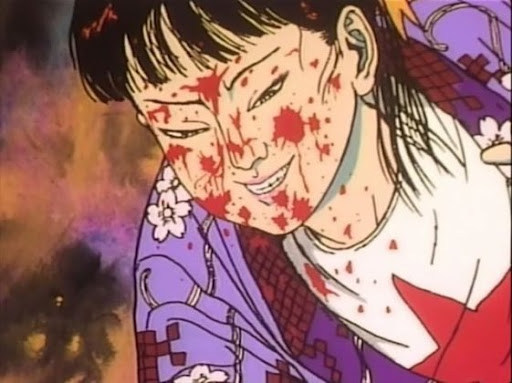
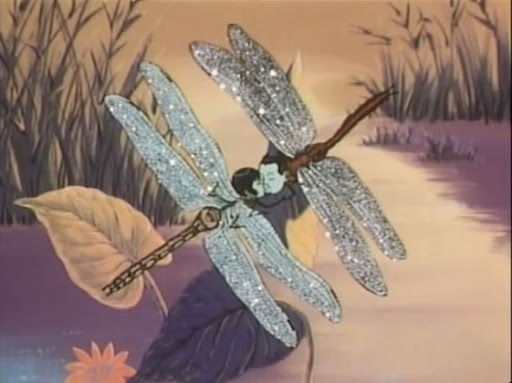
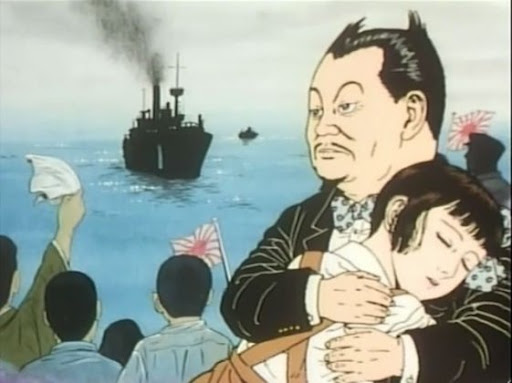
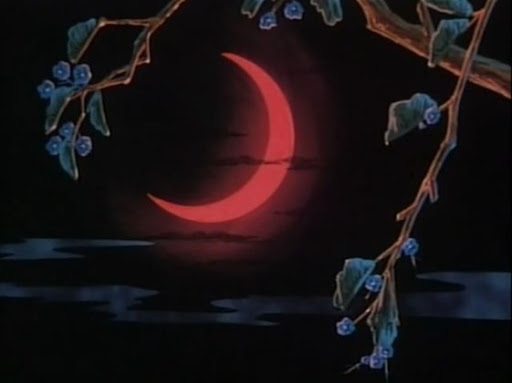
This is one of the very last clean-up jobs for the site, and since poor Midori was forced to live inside such a granuda post for so long, we've decided to republish the new-and-improved version of Midori, which is the anime version of the classic Suehiro Maruo manga Mr. Arashi's Amazing Freak Show. There are plenty of Xvid's floating around of this sobering anime, but we wanted to post Midori properly in DVD. It's a very tough find.


From Johannes Schönherr at Midnight Eye:

An old friend of mine and an avid collector of 16 and 35mm film prints follows a very strict regime when watching movies: "The celluloid must run through a projector in a theater with a big screen and a crowd, the way those movies were meant to be seen. Watching video copies of them on a couch at home doesn't count. It doesn't provide the true experience of the work in question. You can't say that you have seen a film if you've just watched a video of it."

This is fair enough for most films. But Hiroshi Harada, the director of Shojo Tsubaki (let's stay with the original title for the time being) sets the bar much, much higher. He doesn't even allow his film to be shown in movie theaters in Japan, yet alone let them be consumed on video or DVD.

For his screenings, he created incredibly elaborate "freak show" events which encompass live theater, live music, acrobatic acts, wild stage settings, freaky characters let loose on the audience... and a lot of secrecy. His flyers announcing shows and even those looking for performers were deliberately confusing - nobody was supposed to know what was really going on. In the early years, which means the early 1990s after the film's premiere in 1992, he wouldn't even want anyone to know what kind of show Shojo Tsubaki was at all: a movie, an anime, live theater?


"It would have been not interesting if I had given all that info in advance." Harada wrote me in a recent e-mail. "I wanted surprise. The audience suddenly encountering something totally unexpected - that was the point."

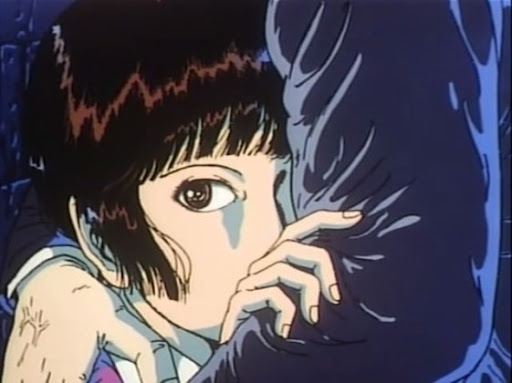
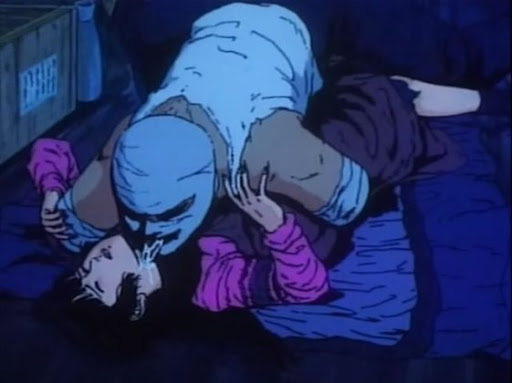
Now, what is Shojo Tsubaki? Well, it's animated, it's on celluloid, it is about a poor young girl who lives a hard life in a freak show circus, and its scenes often switch from being extremely kawaii to extremely graphic, violent, and at times oozing into the territory of far-out sexual fetishism. Sex among disfigured freaks, eye-ball-licking, rape by a disgusting, diseased... it's all there. And yet, Midori, the main character, does find true love here... and then things turn violent again... You never know where the movie is heading. You can't even guess what dangers or pleasures might be coming Midori's way from one second to the next.

Shojo Tsubaki is set in the early years of the Showa emperor's reign, the late 1920s in the Western calender. The original inspiration for the film dates from around the same time: a kami shibai performance going under the same title. Kami shibai translates to 'paper play' or 'picture show' and it dates back to the middle ages. A storyteller would tell a fantastical story in busy market places or wherever else he could find an audience, illustrating his story with a series of drawings. Often, his story was written on the back of the cardboards displaying the pictures to make it easier to do the performance and also to enable the storyteller to sell copies of his act afterwards.


Shojo Tsubaki (which literally means Camelia Girl) is said to have been originally created by a legendary kami shibai performer from the 1920s working under the name Seiun. It was a lengthy performance back then, consisting of 21 chapters and lasting for several hours. One of those original sets of pictures still survives and the play actually has been performed at times as part of the Shojo Tsubaki film events.

The paper play tells the story of a poor family whose father went too far into gambling debts. He runs away and lets the others fend for themselves. Midori, his daughter, goes into the business of flower selling. It's a sad job and one day she is kidnapped by two men and sold to a travelling girl's revue theater where she performs under the name Tsubaki Midori.

In the early 1980s, underground manga artist Suehiro Maruo began to turn the old kami shibai into one of his own disturbing picture stories. The earliest evidence I could dig up was in his 1982 book Das Ungetum der Rosenstck in which the beginning of his unique take on the Midori story is shaping up. The title of the book is of course some sort of flawed German. Though his grasp of the language might have been lacking, Maruo was deeply influenced by 1920s German expressionism and his heroes were Nosferatu, Marlene Dietrich and Doctor Caligari. They all figure prominently in the book - and the drawing style is a fascinating mix of Weimar German influences and vintage Japanese. Truly mesmerizing stuff.


In 1984, Maruo eventually had his final book-length manga of Shojo Tsubaki out in the stores. As already outlined in his Shojo Tsubaki chapter of Das Ungetum, the old kami shibai became now something new altogether... a full blown girl-in-the-freakshow story freely mixing cuteness, violence, perversity and a painstaking accuracy in the depiction of 1920s Japan and its outlaw characters to mindblowing impact.

Enter Harada. He was a young overworked pen-and-inker in the animation industry in 1970's Japan and he hated it. He realized that artistic ambition and the need to sustain oneself had always been a great conflict artists had to fight out with themselves ... but the animation industry didn't even give him the freedom to choose one or the other. The boss told the guys on the drawing boards what to do and they just had to hurry on with their mindnumbing work. He wanted out of the system and he did manage eventually to get out. He quit his job and premiered his first independent animated production City Nocturne in 1979. In 1985, he had 2 new animated works ready for release: Eternal Paradise (Kagirinaki Rakuen) and Lullaby to the Big Sleep (Nido to Mezamenu Komori Uta). The latter, shot on Super 8 and 27 minutes long, told of the adventures of a young boy getting sucked into the violent demonstrations held by leftist groups resisting the construction of Narita Airport. It played the Pia Film Festival in Tokyo, the main showcase for young Japanese independent cinema. Jury member and punk / biker movie director Sogo Ishii loved it and thanks to his lobbying, Harada won a major festival award.

Lullaby had already strong Maruo-esque tendencies: an unpredictable, sexually-charged story, experimental techniques and a main character who underwent a wide variety of forms of bizarre abuse. Even the drawing style appears to be heavily inspired by Maruo. So it seems almost logical that Harada choose a real Maruo as his next project: Shojo Tsubaki.


Knowing that this would demand much bigger resources than his previous films, he went back to the studios and tried to find financing. None was to be found at all. The subject matter of Maruo's book simply scared all potential investors away. Undeterred, Harada sacrificed his life savings, even went to money lending outfits to keep going. Maruo himself had told him "to make the film any way he wanted", as Harada told me. They did stay in close contact during the production period, though, with Maruo providing readings of old-fashioned kanji he had used in his book, advising on what colors to use for scenes and otherwise providing a great influx of ideas - some of which Harada then used. Maruo also lent his original source material to Harada, photo books on Tokyo of the period for example.

Harada started the great work in 1987 - and then continued drawing for 5 years, all by himself. Every single image of the movie was drawn by just one man alone! Harada did however receive a great deal of volunteer support from the Tokyo underground scene of the time for the final completion of his work: from musicians who provided the soundtrack, animators, people at independent documentary film studios, theater groups, even S/M clubs.

In 1992, the premiere of Shojo Tsubaki was held as a giant spectacle in a red tent on the grounds of Mitake Jinja, a Tokyo Shinto Shrine. Amidst strange decorations and exhibits, undergound theater group Aka Neko Za (Red Cat Theater) staged acts which are also performed by the freaks in the movie, and smoke was blown into the audience.


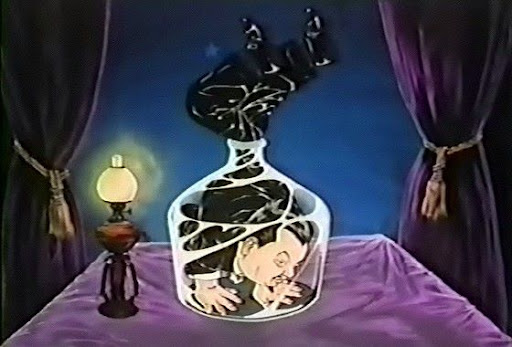
Here's what was projected onto the big screen: To a collage of violent freak show images, an announcer screams out what kind of an incredible story the audience is about to witness - in rhyming vintage carney lingo which almost no young Japanese would be able to understand. Then Midori, a poor girl about the age of 12, selling flowers in 1920s Tokyo. One of her regular customers is a strange man she calls "Mister Bowler Hat" due to the hat he wears. One night, she comes back home and finds her mother dead in her bed, rats already feading on her corpse. She runs away... With nowhere to go she turns to "Mr. Bowler Hat", who turns out to be a freak show impressario going under the name of Mr. Arashi. She joins his travelling circus... and right from the beginning becomes the focus of endless abuse by the real freaks, grotesquely disfigured perverts with bizarre fetishes and giant egos to boot. Relief comes in the form of Wonder Masanitsu, a magician who can squeeze his entire body through the tiny opening of a glass bottle. She falls in love with him but Masanitsu has powerful dark sides too...

It's an animation film, for sure, but the animation is extremely limited. In many instances, it's just a series of drawings, held together by music and dialogues... a modern-day kami shibai. Which of course is quite fitting to the origins of the tale and the time it takes place in.


More screenings of the film followed in rapid succession. Harada himself developed a new modus operandus of screening the work which made it even more difficult to access: he handed audience members who had made a reservation a map of a residential neighborhood. The people had to follow cryptic signs like dolls placed on street corners or folks in strange attire standing by the street to evenutally find an unassuming building and enter its basement. There they were handed candles and had to make their way through a dark labyrinth of corridors and rooms before they could enter the actual venue. Couples were separated, smoke was blown in, fans blew paper snippets resembling cherry blossom petals. While the film ran, theater group members threw objects at the audience that were also thrown around on screen...

In 1994, the film had its international premiere at the Orleans Biennale in France. It has since been shown at a number of Western festivals under a variety of titles like The Girl in the Freak Show or Midori - The Girl in the Freak Show, though without any of the trappings that come with the film in Japan. Harada wouldn't have been able to stage anything similar in a foreign country. The Japanese shows were difficult enough to arrange. Still, Midori stood her ground up on the Western screens, despite being all alone with the vicious freaks in the movie and the quiet lurkers in the seats. Poor girl... so many cruel things have been done to her...

That the film is now available on DVD in France under the title Midori with subtitles in 5 European languages for private home viewing might be the worst abuse Midori ever encountered, though. At home in Japan, however, the film can still be seen only on the rare occasions of a real full-blown freak event, the way it was meant to be seen....


Technical Information:

Title: Midori
Year: 1992
Country: Japan
Director: Hiroshi Harada

Source: DVD5
DVD Format: PAL
DVD Size: DVD5
Container: .iso +mds
Size: 4.32 GB
Length: 0:48:42
Programs used: unknown

Resolution: 720x576
Aspect Ratio: 4:3
Video: MPEG2 @ ~6800 kb/s
Frame Rate: 25 fps

Audio: Dolby AC3 stereo Japanese @ 192 kb/s
Subtitles: English, French, Spanish, Italian, German

Menu: yes
Video: untouched

DVD Extras:
-director's commentary
-interview with Harada
-photo gallery


(Use JDownloader to automate downloading):

Midori Megaupload Links