.:[Double Click To][Close]:.

Online CPM Advertising | Advertising blog
Showing posts with label fuck you tarantino. Show all posts

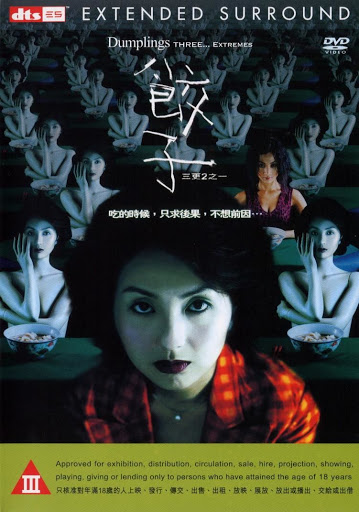
"Fuck You, Tarantino!" Week: Fruit Chan- 餃子/Dumplings (2004)- DVD9 (NTSC Format)

fruit chan- dumplings
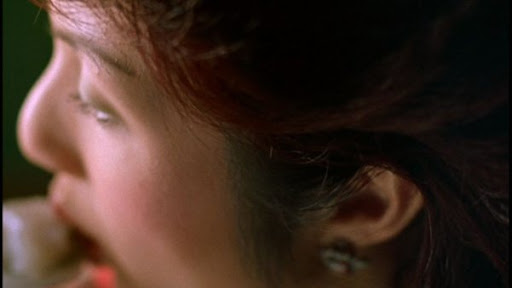
This film is like a string-theoried In the Mood for Love gone horribly wrong. The colors are amazing, and the quality of the DVD9 is superb. Such a beautiful film.

fruit chan- dumplings

From Sandro Matosevic at Stylus Magazine:

Angling off from the gory and sedative veins of the New Asian horror genre, but with an equal measure of stomach-turning boorishness, Fruit Chan’s Dumplings is an exercise in digestive resilience for both vegetarians and omnivores alike. Yet for all its ruthless, laissez-faire narrative ambiguity, the direction of the story is more than approachable. Rather like being blindly led through a curved tunnel with an unpredictable course, Dumplings is quick to careen into unpalatable territory just as you begin get a handle on where you think it’s headed.

This is not so much a horror story as it is a joyous, subtly artistic psycho-thriller. Occasionally nauseating, frequently over the top, this tiny gem of a horror movie delights in its determination to never let go. Chan obviously knows what he wants to do here, but does not make these things clear to the audience. No questions are answered, no reasons are supplied–the final testament of which being the ominous denouement.

fruit chan- dumplings

Fans got a taste of Fruit Chan’s tormenting gore-fest with last year’s pan-Asian horror omnibus Three… Extremes (with contributions from Park Chan-wook and Takashi Miike), where Dumplings was rolled out in reduced, 37-minute long form. Easily the most memorable of the three entries, Fruit Chan was quick to release an “uncut,” extended version of his nightmarish story to satisfy the—ahem—hungry souls yearning for more of this very Asian culinary delicacy. After having seen the cut version, if you’re still unconvinced as to whether the 60 extra minutes are worth your time, the answer is a resounding ‘yes.’ Chan’s film is so compellingly re-watchable that skipping supper won’t be a problem.

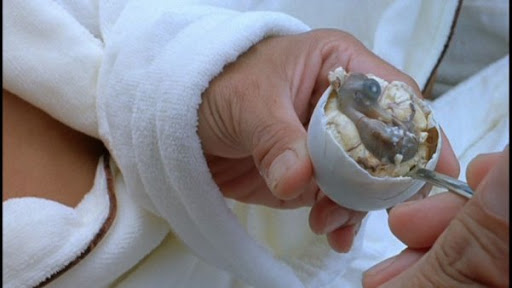
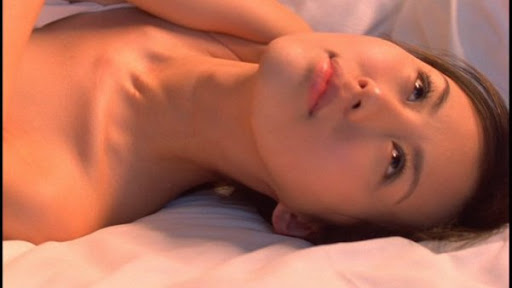
The story itself doesn’t break new ground. Rather Chan handles the subject matter in such a way that the delivery soon outshines any awkward sketchiness presented by the narrative. Fading television actress and Hong Kong socialite Mrs. Lee (Miriam Yeung) is not coping well with aging. In a vain attempt to keep her rapidly-spreading wrinkles at bay and save her failing marriage, she finds herself on a decrepit high-rise in downtown Kowloon, a town in mainland China. There, an attractive yet trashy “young” woman by the name of Mei (Bai Ling) owns a reasonably successful dumplings trade. But this is no place for brunch. Auntie Mei’s dumplings cost a small fortune and offer something money seemingly can’t buy: eternal youth. Mrs. Lee, all too eager to buy into this, soon spirals into a dumpling-heavy diet. This not only dilates the repugnance of the story, but provides Chan with plenty of material to execute his vision from dozens of impetuous perspectives.

fruit chan- dumplings

But what’s in these dumplings that makes them so potent? And how well do they actually work? When you find out, you’ll think twice before ordering that Chinese takeaway again. Chan reveals this surprise early on, thus allowing his focus to shift toward the territory of psychological tension. It should be noted that Dumplings does contain some truly repulsive and disturbing scenes; moments that will turn some stomachs, shake some seats, and ultimately rank within the annals of the horror canon.

Still, the film is not especially scary per se. Rather than simply building up to a memorably heinous ending, Chan layers elements of narrative that extend beyond the conventions of the genre he swiftly defies. The film develops more as social drama than your average Asian gorefest. In the relationship between the two protagonists, Chan attempts to typify an ever-present Chinese class divide. Set against a Hong Kong-Kowloon backdrop, this dynamic further intensifies the cultural analysis he’s attempting to illustrate.

fruit chan- dumplings

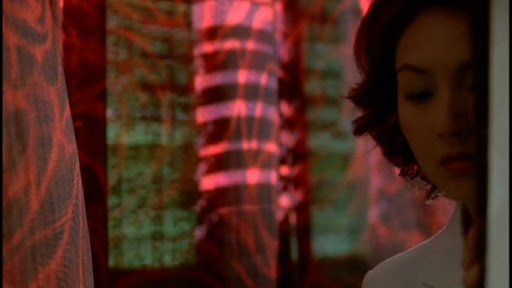
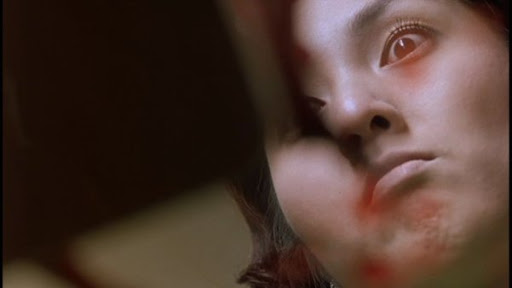
Shot by DP extraordinaire Christopher Doyle, the film is engrossed by an ambience of visual delicacy and allure, while Chan Kwong-Ming’s hilariously over-the-top score contributes to a quietly surreal and claustrophobic reality. These elements further becloud the line between fiction and reality, bridging the gap between the movie’s social ambitions and the overall outlandishness of the content. The eternal quest for beauty and youth, an archetypal theme throughout history, is nothing new for Western audiences, but Dumplings handily eschews cliché. Chan’s tranquil approach peaks with a revelatory ending as satisfying as it is evasive.


fruit chan- dumplings

Technical Information:

Title: 餃子/Dumplings
Year: 2004
Country: Hong Kong
Director: Fruit Chan

Source: DVD9 Retail
DVD Format: NTSC
Container: .iso + mds
Size: 6.95 GB
Length: 1:31:01
Programs used: Unknown

Resolution: 720x480
Aspect Ratio: 16:9
Video: MPEG2 @ ~9300 kb/s
Frame Rate: 29.97 fps

Audio 1: Cantonese- Dolby AC3 5.1 @ 384 kb/s
Audio 2: Cantonese- Dolby DTS 5.1 @ 1536 kb/s
Subtitles: English, 简体中文

Menu: Yes
Video: Untouched

DVD Extras:
- The Story
- Making Of
- Trailers
- Cast & Credits


fruit chan- dumplings

(Use JDownloader to automate downloading)

餃子 Megaupload Links
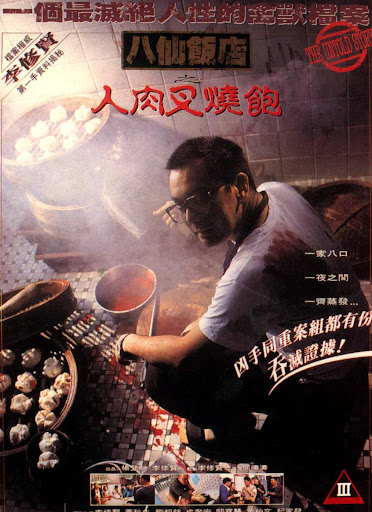


"Fuck You, Tarantino!" Week: Herman Yau- 八仙飯店之人肉叉燒包/Bunman: The Untold Story (1993)- DVD9 (PAL Format)

herman yau- bunman the untold story
All this posting is making me hungry. Some Dim Sum and a beer sure sounds inviting...


herman yau- bunman the untold story

From LoudLon at Horror-movies.ca:

When one thinks of Hong Kong cinema, or Asian cinema in general, the usual images are of cheaply made chop-socky films which feature pony-tailed kung fu masters, extravagant weaponry such as flying guillotines and numerous repetitions of the phrase "But still." But still (heh heh), Asian cinema is every bit as diverse as that of the good ol' US of A, and often more extreme.

Whereas the States have "exploitation films," Hong Kong has Category III films (you can find an explanation for this rating in my review of another HK Category III flick, Dr. Lamb). Most Category III films are, to be perfectly honest, hit or miss. The Untold Story, on the other hand, is one of the best -- though whether that's a good or bad thing depends on one's gag reflex.

The Untold Story starts with a violent prologue circa 1978 Hong Kong. Wang Chi Hang is accused of cheating at mahjongg by his boss. This enrages Wang (even though it's true) and he pummels his boss, then sets him afire.

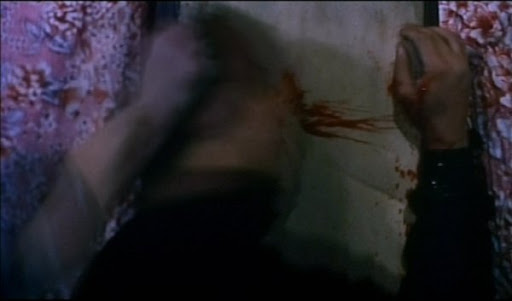
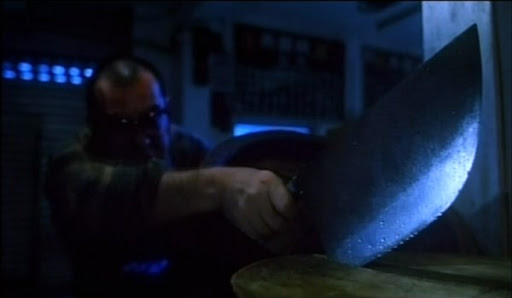
Jump eight years ahead to Macau, in mainland China. A bag full of dismembered body parts washes ashore a beach, and the police are soon called in to investigate. The terribly inept detective unit led by the horn-doggish and equally inept Inspector Lee follow the clues to a diner called Eight Immortals Restaurant, ran by the relocated Wang. We know all along that Wang is the killer, and we also know that Wang has killed his newest boss and his boss's family and ground them into filling for his roast pork buns, which he generously offers to the questioning detectives who waste no time in gorging themselves on the free food.


herman yau- bunman the untold story

The clues, though obvious, are nevertheless considered inconclusive by the police and Wang, though a suspect, is never accused. He continues his murderous deeds by dicing up a pair of nosy employees -- one a man Wang stuffs into the grinder with a cheeky slap on the man's severed ass, the second a woman Wang first rapes with a handful of chopsticks (women, prepare to flinch at this brutal scene) before dropping her into the grinder as well.

Wang is eventually arrested but without the vital evidence, the police decide to beat a confession out of him. Over the course of several days, Wang is deprived of sleep, his rectum is punctured with needles, and blisters are seared onto his back and then ripped open. Finally, Wang breaks and delivers his confession, the titular untold story.

Based on an actual chain of events which transpired in the mid 80's, The Untold Story is a brutal, disturbing and graphic piece of work -- yet also an effective character study. Anthony Wong, one of the bravest of HK's A-list actors, let's loose in the role of the psychopathic Wang. So intense and disturbing is his performance that he was awarded the Best Actor award at the 1993 Golden Horse Awards, the Chinese version of The Oscars, a first for a Category III film.

However, those who object to on-screen violence against children might wish to avoid this sick little number as the entire finale of the film includes the detailed butchering of Wang's boss back in Hong Kong, as well as the boss's wife and many children. And as graphic and unflinching as the sequence is, what makes it more disturbing is the fact that it actually happened.


herman yau- bunman the untold story

Unfortunately, the film also contains its fair share of off-target and distracting comic relief. Not including the film's finale, every scene involving the police is filled with tacky, inane "humor" in the form of lousy one liners and remarkably stupid sex jokes. A female detective with a major crush on her superior is made the butt of her peers' obnoxious, locker-room-level jokes, and every scene involving Inspector Lee sees him appearing with a different hooker on his arm. And while this makes no sense in the film, it has been suggested that legendary HK actor Danny Lee insisted on his character being a ladies' man as an attempt to dispel real life rumors that he himself was homosexual. These ridiculous scenes seem straight out of a Police Academy movie and are almost as painful to watch as Wang's acts of vicious homicide.

For those seeking out this film, you shouldn't have a problem as it's offered by many online video sellers. If you can't find it under this title, you could also try one of the film's six many alternate titles, which include:

Bun Man: The Untold Story
Human Meat Roast Pork Buns
Eight Immortals Restaurant: Human Meat Roast Pork Buns
Human Pork Chop
Bunman's Untold Story
or just plain old Bun Man.

Ultimately, while definitely not for all tastes -- and despite the horrible comic relief -- The Untold Story is Category III filmmaking at its lurid and disgusting finest. For those of you interested in seeing it, I guarantee you'll think twice next time you order Chinese take-out


herman yau- bunman the untold story

Technical Information:

Title: 八仙飯店之人肉叉燒包/Bunman: The Untold Story
Year: 1993
Country: Hong Kong
Director: Herman Yau

Source: DVD9 Retail
DVD Format: PAL
Container: .iso + mds
Size: 7.21 GB
Length: 1:35:29
Programs used: Unknown

Resolution: 720x576
Aspect Ratio: 16:9
Video: MPEG2 @ ~8000 kb/s
Frame Rate: 25 fps

Audio 1: German- Dolby AC3 5.1 @ 448 kb/s
Audio 2: Mandarin- Dolby AC3 2.0 @ 224 kb/s
Audio 3: Cantonese- Dolby AC3 2.0 @ 224 kb/s
Audio 3: English Commentary (Herman Yau)- Dolby AC3 @ 224 kb/s
Audio 4: English Commentary (Antony Wong)- Dolby AC3 @ 224 kb/s

Subtitles: German, English

Menu: Yes
Video: Untouched

DVD Extras:
- Making Of Der Deutsche Synchronisation (German only)
- Comparison of the original and the remaster
- Trailer
- Filmographies: Danny Lee and Herman Yau


herman yau- bunman the untold story

(Use JDownloader to automate downloading)

八仙飯店之人肉叉燒包 Megaupload Links


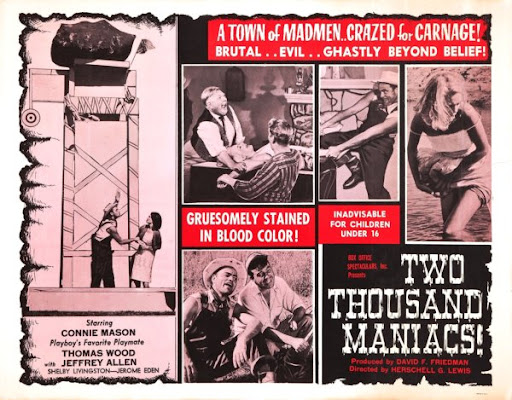
"Fuck You, Tarantino!" Week: Herschell Gordon Lewis- Two Thousand Maniacs! (1964)- DVD5 (NTSC Format)

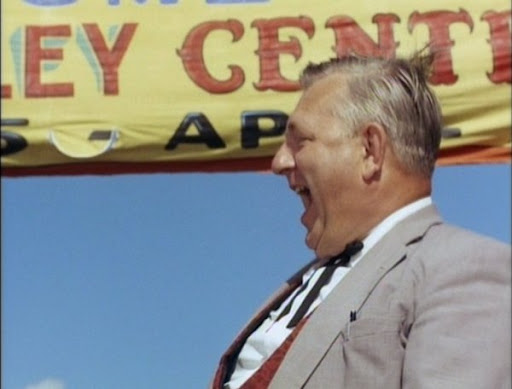
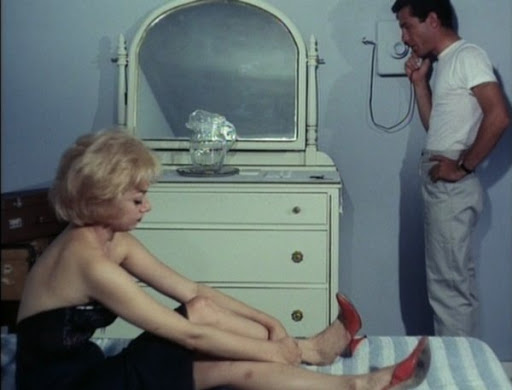
herschell gordon lewis- two thousand maniacs
More classic Herschell Gordon Lewis. Beware, Carpetbaggers!


herschell gordon lewis- two thousand maniacs

From Matt Bailey at Not Coming to a Theater Near You:

A few months ago I, a lifelong Yankee, moved to the South. I am not a complete stranger to the South, my paternal grandfather having been born just a few dozen miles from where I now live, but let’s just say that the appeal of boiled peanuts is a complete mystery to me. Northerners have many misconceptions about the South, that its inhabitants all either tea-drinking belles or unreconstructed rednecks. The thing about stereotypes, however, is that they are often based on truth. In the few months I have lived here, in addition to the many good, sweet people I have met, I have encountered fluttery Scarlett O’Hara wannabees and good old boys so good and old as to make me fear for my safety lest they detect the stink of the enemy on me. It would be unkind of me to intimate that Herschell Gordon Lewis’ cracker revenge fantasy, Two Thousand Maniacs!, is a documentary, but I can’t help but see a little bit of truth in it.


herschell gordon lewis- two thousand maniacs

A film that posits that the South is still so angry, 100 years after the Civil War (excuse me—War Between the States) that its citizens desire nothing more than to exact painful and humiliating revenge on any and all Yankees who happen to wander their way, Maniacs is a gleefully absurd and vicious social satire (as well as something of a spoof of Brigadoon) in the guise of an intensely gory horror film. The rednecks of Pleasant Valley, Georgia are so hell-bent on killing the tourists they have lured to their town, yet they have so much fun doing it, that it is hard not to want them to succeed. The Yankees in the film are such drips anyway (and Connie Mason always makes a good girl-in-peril) that one begins to take delight in the inventive methods of demise the rednecks think up for them. After all, is this not the reason we watch films like this, to get a kick out people (literally) spilling their guts?


herschell gordon lewis- two thousand maniacs

Technical Information:

Title: Two Thousand Maniacs!
Year: 1964
Country: USA
Director: Herschell Gordon Lewis

Source: DVD5 Retail
DVD Format: NTSC
Container: .iso + mds
Size: 4.25 GB
Length: 1:23:45
Programs used: ImgBurn

Resolution: 720x480
Aspect Ratio: 4:3
Video: MPEG2 @ ~6800 kb/s
Frame Rate: 29.97 fps

Audio 1: English- Dolby AC3 Mono @ 192 kb/s
Audio 2: Francais- Dolby AC3 Mono @ 192 kb/s
Audio 3: English Commentary- Dolby AC3 Mono @ 192 kb/s
Subtitles: None

Menu: Yes
Video: Untouched

DVD Extras:
- Original Theatrical Trailer
- Audio Commentary
- Rare Outtakes
- Gallery of Exploitation Art


herschell gordon lewis- two thousand maniacs

(Use JDownloader to automate downloading)

Two Thousand Maniacs! Megaupload Links


"Fuck You, Tarantino!" Week: Herschell Gordon Lewis- Blood Feast (1963)- DVD9 (NTSC Format)

herschell gordon lewis- blood feast
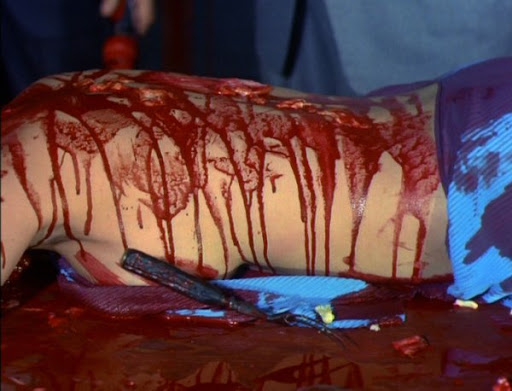
I can't believe that "Fuck You, Tarantino!" Week has carried over into Monday. My fear is that every day will be an homage to His-Lameness. Oh well, if that the way it's gotta be, who am I to complain. Fuck you, Tarantino!...and here's hoping you all had a wonderful Easter! Also, below is a handy meat-cutting tutorial for future holiday meals. This makes me really miss Jesus Week. I loved Jesus Week.


From Antagony and Ecstasy:

It's long been a private suspicion of mine that nearly all of the truly important, influential films in cinema history are also bad. There are exceptions; there always are. But in the main, if a film is extraordinarily significant for this camera technique, or that type of editing trick, or this sort of heroine et cetera, five'll get you ten that the only reason to watch it is is scholarly interest. Take Citizen Kane, for instance: for all its reputation as a groundbreaking technical work, it invented not one damn thing. It just perfected things that were invented in movies that nobody wants to watch anymore, because unlike Citizen Kane, they're boring.

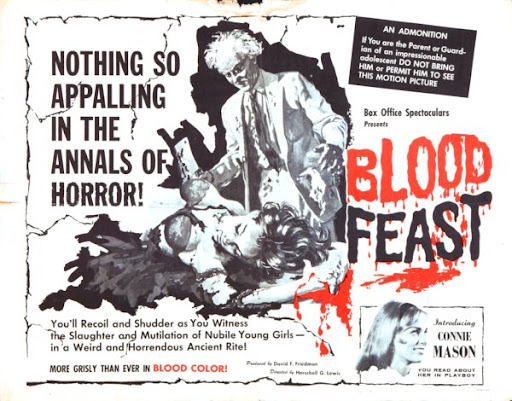
I bring this up because the time has come to take a peek at what is, incontestably, the most Important-with-a-capital-"I" film on the Video Nasties list: Blood Feast, from 1963, which is nor more nor less than the first gore movie ever made. Every one of the 73 other Nasties must claim Blood Feast as one of its key ancestors, as must decade after decade of Friday the 13th movies, and endless Saw sequels. And just as incontestably as it is Important, so too is Blood Feast outstandingly, deliriously bad.

"The first gore movie" is not an altogether objective claim, though there are few people who disagree strongly with this point. Three years earlier, for example, you have Psycho, which was absolutely sold on the basis of its shocking violence; but it was also sold on its unbelievable twist ending and the bulletproof name of Alfred Hitchcock. The many European art-horror films of the '50s and early '60s were notorious for their bloodletting, but just as notorious for their poetic, abstract aesthetic. What makes Blood Feast special is that it was the first movie ever marketed solely on the basis of its violence. Not its plot, not its stars: people went to see it because it was bloody. Really damn bloody. So bloody that it probably would have justifiably won a place on a 1963 edition of a Nasties list, though by the time it was banned in Britain, its effects - along with every single other element of its production - had become hopelessly dated. This is the film about which the most famous story is almost certainly Frank Henenlotter's recollection of how badly it messed up his young self when he saw it as a teen; and if Blood Feast had enough primal power to drive a boy to grow up and direct Basket Case, I think we can agree that it had some real potency back in the day, before decades of bigger, bloodier movies dulled it to the point where I wouldn't blink to see it playing on television on a weekend afternoon.


herschell gordon lewis- blood feast

So, anyway, Blood Feast, the ur-gore picture, was born of one of the great minds in pre-'70s exploitation cinema, Herschell Gordon Lewis. Herschell Gordon Lewis! If you had heard only a quarter of what I have heard about him, and I have only heard very little of all there is to hear, you would be prepared for any sort of remarkable tale. He is probably best remembered today for 1964's Two Thousand Maniacs! and this is well, for Two Thousand Maniacs! is several hundred times better than Blood Feast. But that's skipping ahead: let us tarry around the turn of the 1960s, when Lewis was just a micro-budget filmmaker kicking around Florida, making some ultra-cheap proto-pornographic films of the sort called "nudie cuties". This short-lived subgenre followed an age when the only way to see naked people in cinema was under the guise of "educational" films or naturist documentaries; for the first time, exploitation filmmakers finally decided to just film naked women (and the occasional man) in barely-there plots, without any hint of respectability. These were extremely silly, harmless bits of fluff, romping little comedies with titles like The Immoral Mr. Teas, Nude on the Moon, and Summer with Monika. Nowadays, they're almost as banal as Blood Feast is: it's hard to imagine anyone finding them tremendously erotic, unless they are a 12-year-old boy and the internet is down. In which case it's kind of hard to imagine how he would stumble across a nudie cutie in the first place, but I am drifting from my topic.

Lewis made a few cuties, but as the porn industry started to develop, and Hollywood started toying with the idea of increasingly frank depictions of sexuality, there ceased to be any real money in it. Unfazed, Lewis simply grabbed the next best taboo he could come up with, graphic violence, and made a film that went farther in its depiction of severed limbs and gouged-out eyes than anything ever had. Plus, of course, a quick nipple flash in the first scene, because why the hell not?


herschell gordon lewis- blood feast

Blood Feast was made cheap, for no reason other than to be controversial enough to make money. The rumour is that the price tag for the film was just south of $25,000; even in 1963, that's not much. I do not know whether to say that it shows or not: certainly, the gore is depicted lovingly and unstintingly, but it doesn't seem like a dime was spent on a crew (Lewis shot the film himself), on script re-writes, and definitely not on the cast.

Clocking in at a desperately short 67 minutes, Blood Feast consists of virtually nothing but attempts to stretch out the space between killings as much as possible. The plot, such as it is, consists of an evil caterer named Fuad Ramses (Mal Arnold) who's killing girls and removing a single organ or body part from each one of them; he is chased by the only cops in suburban Miami, both of whom are so incompetent that you almost suspect they'd be capable of directing this movie: Pete Thornton (William Kerwin, using the pseudonym Thomas Wood - you'd do the same) and Frank the captain (Scott H. Hall). Ramses doesn't have the slightest problem staying ahead of them as he prepares something nefarious involving a dinner party being thrown by Debbie Crazyhats - I'm terribly sorry, apparently it's actually "Mrs. Fremont" (Lyn Bolton) - for her daughter Suzette (Connie Mason, a former Playmate), who happens to be flirting with Pete, since they met at a local college's weekly Egyptology class, I think. The dialogue is unclear on this and every other point.

Slightly before the 30-minute mark, Pete and Suzette attend a lecture that goes something like this: "Once upon a time, the Egyptians praised their goddess Ishtar by holding a festival at which they sacrificed 20 virgins and cooked their organs to be eaten by the population at large. Some people say that this is still going on. Boy, that would be terrible! Heh heh." And isn't it cool that in one sentences I was able to repeat no fewer than three of the flat-out lies the film tells about the ancient Egyptians? Right, so we in the audience know what's going on for more than one-half of the movie. But since the only reason anybody has ever watched Blood Feast is to see the gore effects, we shouldn't really hold jaw-dropping structural fuck-ups against it.


herschell gordon lewis- blood feast

By this point, three girls have died onscreen, and there were more before them; the cops have no leads as yet. But finally, one victim manages to stay alive just long enough to interrupt Pete and Suzette while they're necking, and when he goes to the hospital to interview her, she can just barely squeak out, "He said it was for Eetar" before dying. Here's what we know that Pete knows at this point, just to recap:

-Someone is killing girls and removing one part of their body.
-He's doing it for "Eetar".
-The ancient Egyptians used to kill girls and remove one organ from each girl.
-They did it for Ishtar.
-One of the victims was found with a book titled Ancient Weird Religious Rites.

Pete heard the Ishtar lecture at best hours before going to the hospital, and when Captain Frank asks what he makes of this "Eetar" business, he furrows his brow and responds, in one of the stupidest moments of human behavior ever depicted on celluloid:

"Strange... it almost sounds familiar."

I'm not going to bother with the rest, you get the point: Blood Feast is amazingly, amazingly stupid, it can't even flop-sweat its way up to 70 minutes, and I haven't even started on its technical incompetence. This includes, at a minimum, Lewis's amateur-hour cinematography, involving obvious re-framings right in the middle of dialogue, and panning shots where the camera visibly jerks as it moves, as the operator forgot to unlock the tripod pan head first. Or what of the ludicrous musical score, which consists of organ music intercut with a plodding "dum--DUM--dum--DUM" percussion piece?

But surely, the best example of the film's bargain basement ineptitude can be found in the performances. I'll give Kerwin a pass: he was a legitimate actor in later years, and he wasn't even half-bad at it. He's the one person in Blood Feast who has any idea what he's doing, and most of the time you barely notice he's there, so unremarkable is his character.

Because, surrounded by the horrific clown show around him, mere competence isn't enough to stand out from the crowd.


herschell gordon lewis- blood feast

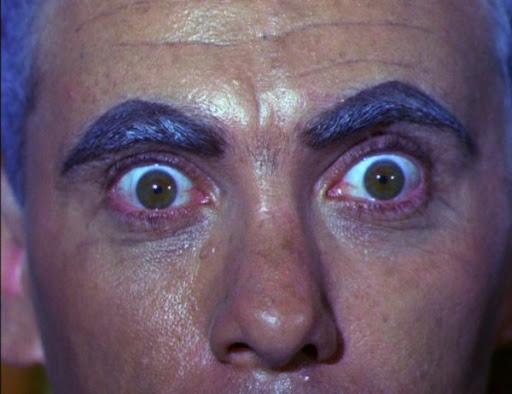
It's hard to know where to begin. With Mal Arnold, who plays Fuad Ramses with a not-quite-accent and a pronounced limp, and communicates his evilness by opening his eyes really wide? He's terrible, and would be the worst member of many a cast, but he barely flickers here. Not when we have Gene Courtier as Tony, a bereaved boyfriend, who gets to have a real swell breakdown with line deliveries like "SHE-HE WHA-HANTED T-HOO LUH-HEAVE! SHE WUH-HUS SCUH-HARED!" (as exact a transcription as I could manage). Nor Connie Mason, who acts exactly the way you'd expect a Playboy Playmate to act: when she delivers her lines, it's like every word is the most exciting thing anyone has ever said, and when she is not speaking, she appears to be asleep. Scott H. Hall probably doesn't deserve anyone's contempt: he was a crewmember, shanghaied into acting when somebody didn't arrive on set; but that doesn't excuse. The stilted rhythm of. His line recitals. Like he was reading cue. Cards, or dialogue. That he wrote on his hand.

And last but definitely not least, is Lyn Bolton, whose extremely... eager performance as Mrs. Fremont translates into a bizarre and wildly inconsistent New England accent and- well, you saw that photo I posted earlier. You saw her saucer eyes.

It doesn't help that these actors have to deliver dialogue (by nudie cutie expert Allison Louise Downe) that includes such choice bons mots as:

"Call the Fremonts, fast! And for Pete's sake, don't let them eat anything!"

"Mrs. Fremont, I'm afraid this feast is evidence of murder!
"Oh dear! The guests will have to eat hamburgers for dinner tonight."

"Fuad Ramses? Nope, never heard of him... oh, just like Dr Flanders’ speech, huh?... Ishtar! Heh. Well, I hope it isn’t exactly like Dr Flanders described it!"

"Well Frank, it look like one of those long, hard ones."


herschell gordon lewis- blood feast

Finally the gore: the theoretical reason that I've dragged you here in the first place. What can I say? $25,000 buys you plenty of red paint, but not the talent to apply it in ways that look halfway decent, nor the knowledge of how to light and frame it.

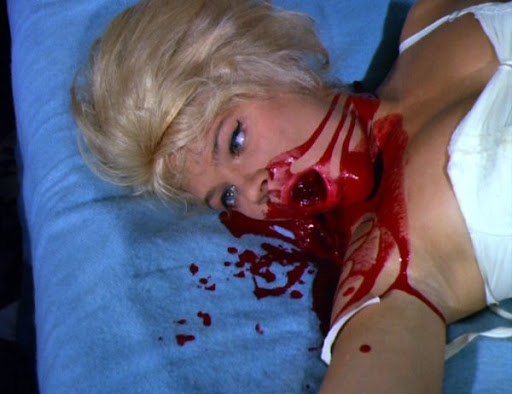
[...]There's one moment that most people agree almost works, when Fuad Ramses rips a woman's tongue out, leaving a messy pool of blood running out of her dead mouth; the effect is pretty damn gross (and it looks like a real animal tongue that Arnold is holding), but it's all ruined when you notice the actress steadily wobbling her jaw to force more of the red goo out. Frankly, that anyone could respond to this movie with anger, fear, or disgust, rather than constant peals of laughter dumbfounds me.

For by all means, Blood Feast is hilarious: one of the funniest "so bad it's good" movies I've seen in a long, long time, and at 67 minutes, it couldn't be easier to fit into your schedule. So watch it, is what I'm saying: watch it yesterday. Lovers of crap horror (and if you're not a lover of crap horror, I doubt you got anywhere near this far into the review) owe it to themselves, for this is one of the masterpieces of truly feckless cinema, an epic fail of such grandeur that Ed Wood himself would be hard-pressed to do better. Worse. You know what I mean.

Body Count: 7, one of them a priestess to Ishtar killed in a 5000-year flashback.

Nastiness Rating: 1/5, not at all Nasty. I categorically refuse to believe that violence presented with such utter incompetence as we find in this film could possibly contribute to the downfall of any society that isn't dominated by three-year-olds.


herschell gordon lewis- blood feast

Technical Information:

Title: Blood Feast
Year: 1963
Country: USA
Director: Herschell G. Lewis

Source: DVD9 Retail
DVD Format: NTSC
Container: .iso + mds
Size: 6.8 GB
Length: 1:06:58
Programs used: ImgBurn

Resolution: 720x480
Aspect Ratio: 4:3
Video: MPEG2 @ ~7500 kb/s
Frame Rate: 29.97 fps

Audio 1: English- Dolby AC3 Mono @ 192 kb/s
Audio 2: English Commentary- Dolby AC3 Mono @ 192 kb/s
Subtitles: None

Menu: Yes
Video: Untouched

DVD Extras:
- Theatrical Trailer
- Audio Commentary
- Rare Outtakes
- Gallery of Exploitation Art
- "Carving Magic" Short Film (played above)


herschell gordon lewis- blood feast

(Use JDownloader to automate downloading)

Blood Feast Megaupload Links


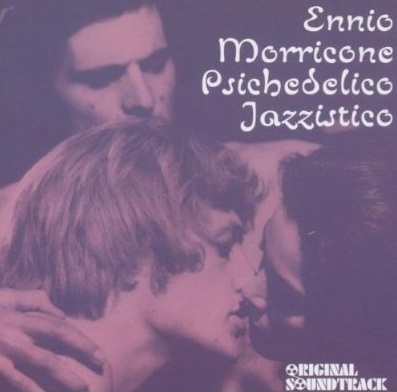
"Fuck You, Tarantino!" Week: Ennio Morricone- Psichedelico Jazzistico (2003)- EAC CD Rip (FLAC)

ennio morricone- psichedelico jazzistico
More Morricone...and he's doing free-form Jazz.


ennio morricone- psichedelico jazzistico


From The Music Fix:

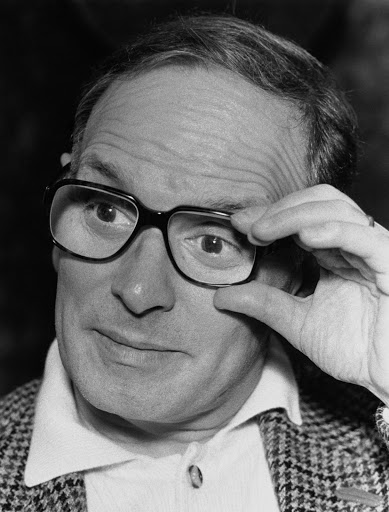
Mention Ennio Morricone as a film composer and you’ll instantly recall his sterling work on Sergio Leone’s mid-sixties’ Dollars trilogy, in which his film scores grabbed the spaghetti western by the throat and branded it his own almost overnight. Mention Morricone, and you’ll also instantly recall his haunting efforts from the eighties, such as the majestic beauty of Roland Joffe’s The Mission or Giuseppe Tornatore’s deeply poignant Cinema Paradiso.

Conveniently, él records have released a compilation that helps to join the dots between these two periods, notably the late-sixties and early-seventies. Entitled Psichedelico Jazzistico, the selected cuts on offer cull all of the strongest themes from what was essentially a non-Hollywood era for Morricone. This period saw the Italian composer boldly experiment with changing avant-garde styles and a looser, more liberated attitude in European cinema. It was also a period that saw the psychological-thriller genre flourish, hence three eerie cuts from Dario Argento’s The Bird With The Crystal Plumage open Psichedelico Jazzistico, and slip effortlessly into selections from Argento’s Four Flies On Grey Velvet, itself pushing towards more haunting territory. You can sense Morricone’s desire to break away from conventional scoring and opt for a more eclectic, jazz-based sound, typified by contemporaries such as Lalo Schifrin and Bernard Herrmann.


ennio morricone- psichedelico jazzistico

Sexual study One Evening At Dinner is far more lounge-like with regards to Morricone’s approach, and at times there are even shades of Bacharach-style chord-transitions that casually sit within the background, or a rockier Hugo Montenegro-styled angle. Italian romantic-drama G-Force throws in two contrasting themes - Sospeci fra le Navole is characteristically dramatic, whilst Forza G is all edge with pulsating bass-line. Studio di Colore is similar, taken from the 1969 She And He. Investigation Of A Citizen Under Suspicion is by far the tensest of Morricone’s offerings. The only pity is that the final two extracts, taken from Il Gatto, were recorded in the late-seventies and sound overly-dated in their reliance on keyboards. Still, Mariangela e la Seduzione is novel in that the lead female vocalists manages to sound like she is singing and being pleasured at the same time.

Whilst deliberately skimming the surface over a period of almost fifteen years, Psichedelico Jazzistico still serves as a perfect bridge between most casual collections of ‘classic’ Morricone recordings. It will save you paying over the odds for that rare import, and it streamlines the late-sixties and early-seventies period of Morricone down to his collctible essence. Psychedelic jazz indeed!


ennio morricone- psichedelico jazzistico

Technical Information:

Artist: Ennio Morricone
Album: Psichedelico Jazzistico
Year: 2003

Audio Codec(s): FLAC
Encoding: Lossless
Rip: EAC split tracks + .cue
Avg. bitrate: 692 kb/s
Sample rate: 44100 Hz
Bits per sample: 16
Channels: 2
File size: 273 MB
Length: 0:55:13


Tracklisting:

01. Plume di Cristallo (5:14)
02. Non Rimane Piu Nessuno (3:18)
03. Corsa Sui Tetti (Black Glove Undergrount Pt. 1) (5:00)
04. Come Un Madrigale (3:39)
05. 4 Mische du Velluto Grigio (5:50)
06. Sauna (4:55)
07. Alla Luce del Giorno (3:04)
08. Uno Che Grida Amore (4:31)
09. Sospeci Fra Le Nuvole (3:46)
10. Forza 3 (Psichedelico Jazzistico) (1:42)
11. L'Assoluto Naturale (3:37)
12. Studio di Colore (1:12)
13. Indagine Su Un Cittadino al di Spora di Ogni Sospetto (3:28)
14. Terazza (2:58)
15. Mariangela e la Seduzione (3:00)


ennio morricone- psichedelico jazzistico


Psichedelico Jazzistico Megaupload Link


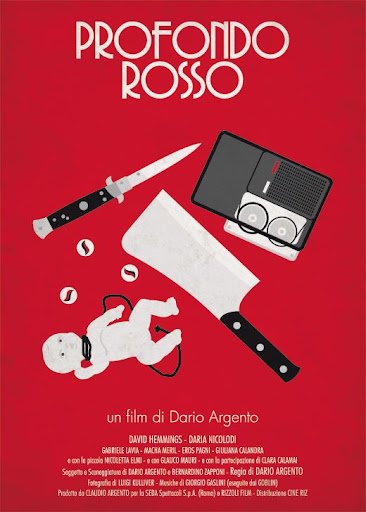
"Fuck You, Tarantino!" Week: Dario Argento- Profondo Rosso/Deep Red (1975)- BluRay Rip (720p-x264)

dario argento- profondo rosso- deep red
If my count is correct, this is the third BluRay Argento film we've posted. Damn, we're good.


dario argento- profondo rosso- deep red

From Ed Gonzalez at Slant Magazine:

Deep Red was Dario Argento's first full-fledged masterpiece, a riveting thriller whose secrets carefully unravel via a series of carefully calibrated compositions that become not unlike virtual gateways into Freudian pasts. Like Argento's ever-flowing camera, Deep Red's killer is everywhere—the protagonist's claustrophobia becomes a physical response both to the film's oppressive mise-en-scène and Argento's formal framing. Unlike The Cat O' Nine Tails, there's no silly scientific rationale here for the film's murders (indeed, there are no easy answers). Argento delicately grapples with issues feminism and masculinity within Deep Red's meticulously visual exegesis of a troubled psyche. If the truth in Antonioni's Blowup was inscribed in a photograph of a potential crime scene, truth in Deep Red is stamped in the memory of pianist Marcus Daly (David Hemmings, also the star of the Antonioni classic). The film's murders are gorgeous to the point of distraction. This is Argento's intent though—to scare and awe the spectator so that he or she won't see the obvious. The film's final piece de resistance evokes the elusiveness of memory but, more importantly, shows that the identity of the film's killer was always available to the careful spectator.

If Ennio Moriccone's lullabies from The Cat O' Nine Tails seemed discordant, Deep Red's Goblin score is the perfect compliment to Argento's id-driven narrative. The film's recurring lullaby is one from the killer's troubled past, chillingly played on a handheld tape player before every crime. As the film progresses, the airiness of this music gives way to retro organ sounds that owe plenty to the legendary underground soundtrack to Vampyros Lesbos. A remarkable tableaux mort punctuates the film's opening credits as the menacing Goblin score is overwhelmed by the sounds of the lullaby. Argento's subversive static shot could be a snapshot torn from the pages of a Grimm photo album. A murder is committed (evoked merely by the dueling shadows of the victim and killer) in a room containing a table, a record player and a garish Christmas tree. A bloody knife falls to the floor and a child's feet step into the frame. (Interestingly, the scene brings to mind the opening sequence of John Carpenter's Halloween, released three years after Deep Red.) The lullaby fades out and the credits—here, standard white letters on a black background—recommence. Is this a scene from the past? Is it a dream? Is the child a girl or a boy? Did the child commit the murder? But even before you ask these questions, you might forget you ever witnessed this distant memory.


dario argento- profondo rosso- deep red

Argento's camera hypnotically zooms in on Marcus (Hemmings) after an unsuccessful jam session. Standing up, he utters: "Too clean. Yes, too precise. Too formal. It should be more trashy. This kind of jazz came from the brothels." This is perhaps the first instance of self-reflexivity in Argento's films. Indeed, part of Deep Red's success is Argento's ability to transcend the trashy material with the remarkable formalism of his camera. Before Marcus can even finish his speech, Argento begins to zoom into a room where a parapsychology conference is taking place. This steady accumulation of shots zooming in on their subjects is strangely unnerving, as if Argento is stealthily luring us into his world. Three figures are seated at a table on the auditorium's stage: the telepathic Mrs. Helga Ulman (Macha Méril), animal-enthusiast Professor Giordani (Glauco Mauri) and the supposedly clairvoyant Mario Bardi (Piero Mazzinghi). While Giordani's discussion on telepathy in animals may amount to little more than gibberish, it seemingly prefigures the themes that highlight and undermine Argento's Phenomena. Helga "can see thoughts just as they are formed" and is suddenly overcome with intense emotions. She mumbles something about a nursery rhyme, a house and a hidden body while envisioning a sharp knife entering her torso. There's a killer in the room (perhaps the killer from the film's opening flashback scenario?) and he/she will commit more murders. Joyously aware of his cinema as a kind of performance art, Argento zooms out of the conference and the door's surrounding red drapes close before the camera.

The film's camera pans over objects lying on a black table: a miniature crib being toppled by a marble, a voodoo doll made of red yarn, a child's drawing depicting a murder and a series of knives. More remarkable than the rich colors that highlight this scene and others like it are the psychoanalytic nature of Argento's close-ups. Argento likens the innocence of youth with killer objects, evoking the murder's troubled past. In one repulsive close-up, the killer applies mascara to one of his or her eyes. Is the killer a woman or, as a later scene may suggests, a transvestite? Helga is speaking on the phone with a friend when she hears the sounds of the film's nursery rhyme. Then, a knock on the door—it's the killer, who barges into the apartment even before Helga can run away. She is axed with such brutal and expert precision that Argento doesn't even allow her to ponder just how expertly he predicted her own demise. Argento's camera crawls over Helga's fabulous furniture (there's a table in the shape of the Star of David in one part of the room—during her funeral, it's revealed that she's Jewish) before the killer's gloved hands enter the frame and settle on Helga's notes. The killer must erase all evidence of the woman's premonition.


dario argento- profondo rosso- deep red

Just before Helga is killed, Marcus is seen having a conversation with his alcoholic best friend, Carlo (Gabriele Lavia). The men discuss politics, music and human survival before the grotesque statue of a Greek God hovering above a fountain. Marcus walks past the bar where he works as a performer, which Argento purposefully and eerily models after Helnwein's "Nighthawks" (a.k.a. "The Boulevard of Broken Dreams"). It's no coincidence that Argento chooses the Helnwein painting to emulate. Not unlike the painting's famous stars (Marilyn Monroe, James Dean), Argento's characters resemble ghosts. Not only does most of the film take place at night and the streets are barely populated. Even the few people that walk through the streets of Argento's ghost world come to resemble mannequins trapped in time. The Greek statue separates Carlo and Marcus during a conversation later in the film. Not only does the statue's nakedness serve to emphasize the honesty of their relationship but also seemingly anticipates the revelation of Carlo's homosexuality.

Marcus watches as Helga's face is thrust through a window and her neck is pierced with shards of glass. Marcus enters Helga's apartment (she lives below his own apartment) and pulls Helga away from the window. The hallway in Helga's apartment is lined with a series of small Munchian paintings. It is here that Argento forces the spectator to take on Marcus's point of view as the camera begins to track down the hallway. A small niche to the side of the hallway reveals a series of pale, gruesome portraits. Staring out onto the promenade below, Marcus sees a figure clad in black running from the building. Carlo drunkenly walks by the bar, seemingly oblivious to what has just transpired. Once the police arrive and Marcus makes his way down Helga's hallway, he comes to believe that a painting has been stolen from the apartment but seemingly pays little attention to this suspicion. Later, when Marcus and Carlo discuss the events, Carlo suggests the obvious: "But maybe the painting was made to disappear, because it represented something important." This missing painting, of course, is the ultimate clue to solving the identity of the film's killer though Argento doesn't call too much attention to David's trip down the hallway should the spectator solve the mystery entirely too early.


dario argento- profondo rosso- deep red

At the crime scene, Marcus is introduced to an overzealous reporter named Gianna Brezzi (Daria Nicolodi), who publishes his picture in the local newspaper, thus perpetuating the killer's pursuit of Marcus. Throughout the film, Argento seemingly challenges Marcus's masculinity through a series of comic encounters with Nicolodi's feminist construct. Carlo has already built a wall between himself and Marcus when he says, "I am the proletarian of the pianoforte while you are the bourgeois. You play for the sake of art and you enjoy it. I play for survival." It's no coincidence then that a police officer seems to ridicule Marcus for being a pianist. Marcus is defensive, saying: "You think playing the piano isn't a job? What is it then, a joke?" Marcus later tells Gianna that artists are very sensitive people while reporters have the hides of elephants. Gianna proclaims that she became a reporter in order to be independent from men while Marcus humorously acknowledges the source of his musical talents: "My psychiatrist would say that it's because I hated my father, so when I bang the keys I'm really bashing his teeth in." Though Marcus sets himself up as a sexist and a self-acknowledged weakling, Argento is more than willing to deflate his fragile ego. Gianna challenges Marcus to a round of hand wrestling—she beats him twice though he calls her a cheater on both occasions.

Looking for Carlo, Marcus makes small talk with his friend's mother, Martha (Clara Calamai). Before disclosing her son's location, the woman rambles on about an acting career that she once had to put on hold. On the walls are pictures from her supposed film career (the stills, in fact, are those from Calamai's early career in Italian cinema). Marcus finds Carlo inside his lover Massimo Ricci's (Geraldine Hooper) apartment. Carlo's secret is out and he's clearly resentful: "Good old Carlo, he's not only a drunk but a faggot as well." Since Marcus is so used to having his masculinity called into question, he barely bats an eye when he discovers Carlo's secret. Gay characters figure prominently in Argento films though they've never been revealed to be the film's killers. Since Argento suspects everyone equally, the spectator has to turn to his mise-en-scène for clues. A lesser director may have pegged Massimo as the Deep Red killer. Seeing as he is a transvestite, this would explain the earlier close-up of mascara being applied to an eye. Interestingly, Massimo is never heard from again. He is merely Carlo's considerate lover who just happens to be effeminate.


dario argento- profondo rosso- deep red

Argento's camera zooms back from an archway, pans up the outside of his stage-like apartment and zooms into his rehearsal studio. The camera then pans across the staff on Marcus's sheet music, revealing that the pianist is currently composing a song. Argento's hideously silent cinematic language remarkably evokes Marcus's claustrophobia. Marcus doesn't notice that plaster dust has fallen from the ceiling and onto his piano. Once Marcus realizes that someone was walking on the roof and has invaded his space (he knows because he can hear the lullaby), he continues to play his music in order to give the killer the illusion that he's lost in his music. With one hand he locks the door to his studio and calls Gianna for help. From outside the door the killer is heard whispering, "This time you're safe. But I'll kill you sooner or later." Once Marcus manages to secure an LP that contains the killer's lullaby, Professor Giordani recommends that Marcus read "Ghosts of Today and Legends of the Modern Age," by Amanda Righetti. Sitting inside an unusually spacious library chamber, Marcus reads from the book's first chapter ("The House of the Screaming Boy") and comes across a ghoulish tale of ghostly wails and haunting lullabies. Marcus believes this is a clue and begins to search for the house pictured inside the book.Amanda Righetti is about to pay the price for transcribing the killer's dangerous past. Stepping into her country house, she notices a toy baby hanging from a rope. Perturbed though not quite scared senseless, Amanda decides to stay inside her home. Soon the lights go out and Amanda's precious birds turn against her. Argento remarkable use of widescreen teases the spectator with the possibility that the killer can jump into frame any second—most remarkable is that the killer doesn't! Amanda dies inside her bathroom during a set piece that arguably remains Argento's greatest to date. Amanda's death is Argento's ingenious wink at the spectator.


dario argento- profondo rosso- deep red

Emphasizing the nature of Deep Red as a literal puzzle, Argento fashions the woman's demise as a virtual clue waiting to be cracked. After smashing Amanda's teeth against the bathroom counter, the killer turns on the bathtub's hot water and gives the woman a deadly facial. Amanda falls to the floor and is left to scribble a last-minute note on her steam-coated linoleum walls.Marcus stumbles on Amanda's body and informs Giordani of the bizarre positioning of the woman's finger, almost as if she were pointing to something. Giordani doesn't give Marcus's observation a second thought until he arrives at Amanda's house. There he meets Amanda's maid, who cleans the blood off the bathroom sink. The anticipation is unnerving—how long will it take for Giordani to break the linoleum code? As the bathroom fills with hot steam emanating from the sink, the message on the wall reappears: "IT WAS." As if this anticipation weren't grueling enough, Argento continues to daringly leave the spectator in the dark. Argento's long shots truly evoke the pervasiveness of killer's reach. From the library to the Amanda's home, the killer is seemingly everywhere. Regardless of whether the killer spent the night at Amanda's or not is beside the point—Giordani is a dead man. Sitting in his study, Giordani witnesses a mechanical doll advancing in his direction. Why would the killer go to such bizarre lengths to kill Giordani? No matter. The doll shocks Giordani into submission—perhaps more frightening than his death is the way his bold-faced horror turns into smug self-satisfaction. Curiously, the doll's gangly movements seem to call attention to the rigorous nature of Argento's camera and Giordani's formal death.


dario argento- profondo rosso- deep red

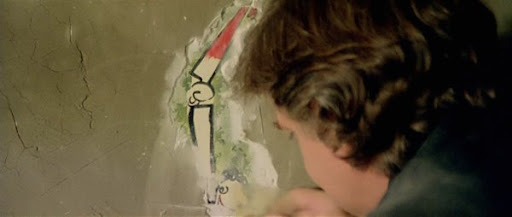
Marcus stumbles upon "the house of the screaming child" pictured inside Amanda's book. After meeting the home's elderly caretaker, Rodi (Furio Meniconi), Marcus witnesses a strange transaction between the man and his young daughter. Slapped for what appears to be no reason, Olga (Nicoletta Elmi) laughs ghoulishly in appreciation. Argento pans down Rodi's legs and reveals a lizard struggling against death. Pierced by what appears to be a small sewing needle, the lizard seemingly dies as a consequence of living next to a house of demons. Some have made a connection between the lizard and Giordani's study of animal telepathy though I'd wager that the animal is little more than Argento's favorite reptile. (Lizards appear in Opera, Trauma and, most curiously, in Inferno while animal telepathy plays a key role in Phenomena.) Making his way into the house, Marcus discovers a child's gruesome drawing concealed on a wall covered in plaster. The drawing depicts the film's opening tableaux mort: a bloodied older man screams as a smaller figure prepares to stab him. In the background a Christmas tree keeps watch. To Marcus, the image suggests that the small child must now be the hatchet murderer.

While Marcus certainly has enough to go on, Argento once more winks at his audience. After Marcus leaves the room of the screaming child, a small portion of the wall's plaster falls to the ground revealing a missing piece of the puzzle: next to the dying man appears a third figure that seemingly partook in his Christmastime murder. Argento cleverly sets up a later set piece when Marcus drives past a group of trucks from the Road Assistance for Heavy Transportation. Looking closely at the picture of the home as it appears in Amanda's book, Marcus discovers that a room has been sealed off. How remarkable is it that Deep Red comes to resemble a 1000-piece puzzle slowly and coming together to reveal a horrifying secret? Marcus discovers a decayed body sitting on a chair (the man in the child's drawing) in the hidden room though he's unceremoniously knocked unconscious before he can make any sense out of this discovery. Marcus awakens with Gianna hovering above him, the mansion burning to pieces in the background. Judging by Gianna's grim expression, Argento teasingly suggests she might be the killer before she begins to take pleasure in the fact that she pulled him from the blaze. Remember: Deep Red is more than a virtual puzzle, it's also a game of sexual politics.


dario argento- profondo rosso- deep red

Gianna calls the fire department from Rodi's home and Marcus walks into Olga's room only to discover a picture hanging on her wall that is identical to the one drawn by the screaming boy. "She's a strange child. She likes the macabre," says Rodi to a dumbfounded Marcus. To Marcus, it's impossible of course for the girl to have drawn a painting so remarkably similar to that of the screaming boy's. Having seen the painting at the Leonardo Da Vinci School while she was cleaning up the archives, the girl unknowingly recreates the tortured past of the very boy who lived in the house next to her own. Once Gianna and Marcus make it to the school and find the screaming boy's sketch, a signature on the drawing seemingly links Carlo to the crimes. Even though Carlo stabs Gianna with his knife, the careful spectator already knows he is innocent. Remember: he was speaking with Marcus at the piazza during the time of Helga's demise. Standing before Marcus, a gun-wielding Carlo admits to the crimes before threatening to shoot his best friend. When the police arrive, Carlo runs into the street and is violently dragged to his death when his foot gets stuck on a hook attached to one of the Road Assistance trucks. Marcus, though, isn't convinced of Carlo's guilt and heads back to the scene of the original crime. There he comes in contact with the many faces of the film's killer but not before he's forced to displace memory into the present.

The elements of Argento's "animal trilogy" (The Bird with the Crystal Plumage, Cat O' Nine Tails and Four Flies on Grey Velvet) don't particularly lend themselves to explanations within any system of associations implied by the rest of the filmic experience. Deep Red's elements on the other hand work as a group collective, shaping and reshaping Marcus's view of reality as the film moves along. If Blowup is a film about the impossibility of perception, then Deep Red is entirely more hopeful. Marcus solves the identity of the film's murderer as he makes one final trip down Helga's hallway. What he first thought was a missing Munchian painting was indeed the killer's reflection on a mirror that still hangs in the niche adjacent to the hallway. (This fabulous revelation was always available to the spectator should they have been unfortunate enough to replay Marcus's earlier trip down the hallway using their rewind button.) Marcus makes the final connection just as he turns to greet the film's killer: Carlo's mother, Marta. She is the deluded biddy whose acting career was put on hold because of her husband's demands. Her resentment for the man led to his Christmas slaughter. Take Marta as Argento's doppelganger—the elaborateness of Deep Red's murders have sprung forth from the mind of a stifled artist and feminist. Marta's final performance is especially gruesome not because of the fabulous nature with which she meets her demise but because Marcus is forced to stare at his reflection in a pool of blood. Once again, Argento emphasizes the relentlessness of the gaze and the importance of "looking" in order to get the supreme truth.


dario argento- profondo rosso- deep red

Technical Information:

Title: Profondo Rosso/Deep Red
Year: 1975
Country: Italy
Director: Dario Argento

Source: BluRay Retail
Video Codec: 720p-x264
Container: .mkv
Size: 8.08 GB
Length: 2:06:34
Programs used: Unknown

Resolution: 1280x572
Aspect Ratio: 2.35:1
Video: MPEG4 AVC H264 @ ~12500 kb/s
Frame Rate: 23.97 fps

Audio: Italian- Dolby AC3 5.1 @ 640 kb/s
Subtitles: English


dario argento- profondo rosso- deep red

(Use JDownloader to automate downloading)

Profondo Rosso Megaupload Links


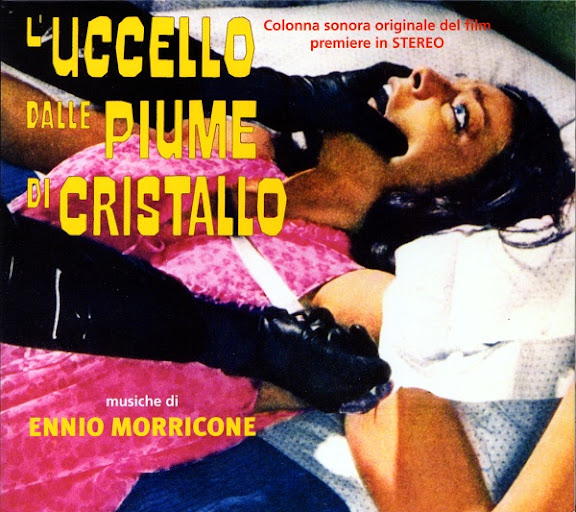
"Fuck You, Tarantino!" Week: Ennio Morricone- L'uccello dalle piume di cristallo/The Bird with the Crystal Plumage OST (1970)- EAC CD Rip (FLAC)

 ennio morricone- bird with the crystal plumage ost
Here's the Morricone soundtrack to the film. Fuck you, Tarantino!


 ennio morricone- bird with the crystal plumage ost


Technical Information:

Artist: Ennio Morricone
Album: L'uccello dalle piume di cristallo/The Bird with the Crystal Plumage OST
Year: 1970

Audio Codec(s): FLAC
Encoding: Lossless
Rip: EAC split tracks + .cue
Avg. bitrate: 660 kb/s
Sample rate: 44100 Hz
Bits per sample: 16
Channels: 2
File size: 301 MB
Length: 1:03:55


Tracklisting:

01. Violenza inattesa (4:10)
02. Non rimane piu nessuno (3:19)
03. Corsa sui tetti (5:02)
04. Se sei stonato (0:48)
05. Svolta drammatica (2:45)
06. Fraseggio senza struttura (4:18)
07. La citta si risveglia (3:10)
08. L'uccello dalle piume di cristallo (1:25)
09. Silenzio nel caos (2:12)
10. Piume di cristallo (5:14)
11. Fraseggio senza struttura (#2) (2:29)
12. Piume di cristallo (#2) (1:42)
13. Senza nel caos (#2) (2:22)
14. Fraseggio senza struttura (#3) (4:10)
15. Piume di cristallo (#3) (3:57)
16. Svolta drammatica (#2) (2:24)
17. Fraseggio senza struttura (#3) (4:51)
18. Piume di cristallo (#4) (3:10)
19. Fraseggio senza struttura (#5) (4:18)
20. Piume di cristallo (#5) (2:10)


 ennio morricone- bird with the crystal plumage ost


L'ucello dalle piume di cristello Megaupload Link


"Fuck You, Tarantino!" Week: Dario Argento- L'uccello dalle piume di cristallo/The Bird with the Crystal Plumage (1970)- BluRay Rip (1080p-x264)

dario argento- the bird with the crystal plumage
I'm always amazed by first-time directors whose first outings are so mature that it seems like they'd been doing it forever. Orson Welles, Vincent Gallo...perhaps they were genetically coded to direct. So was (is) Dario Argento. The Bird with the Crystal Plumage was his first directorial job, and one would never know it because of his inate abilty to compose a perfect shot. Also, his ability to move from near-dark to deep, primary well-lit color in a scene is an amazing feat. And yes, I realize that the acting is stilted, and there isn't the psychedelic color scheme's of Suspiria...but his use of darkness in this film is mind-bending. The guy's a damn genius.

I'll shut up now. Enjoy!


dario argento- the bird with the crystal plumage

From Stuart Galbraith IV at DVD Talk:

Perhaps DVD's greatest legacy, at least for many die-hard movie fans, is how it introduced them to movies and genres up to then unavailable except in heavily bastardized versions on television and tape, or through the murky underworld of murky bootlegged videos. Thanks to DVD's popularity and pervasiveness, the ability to buy, sell, and trade DVDs on the Internet, and a growing demand that facilitated boutique labels like Blue Underground, Fantoma, Mondo Macabro, and All Day Entertainment, movies and even whole genres we may have only vaguely heard about suddenly became available, and in quality transfers that enabled viewers to see films in a good approximation of the theatrical experience, as experienced by moviegoers in their country of origin. German mysteries, Indonesian action films, Bollywood musicals, Hong Kong comedies, Spanish horror films, Soviet Bloc science fiction dramas - you name it.
One of the most enjoyable and surprising discoveries of this DVD age has been the Italian Giallo film, Hitchcockian mystery-thrillers noted for their stylish direction, cryptic titles, imported American and British stars, twist (and sometimes multiple twist) endings, and occasional horror elements, particularly the slasher film which giallo helped define. Giallo have something of an overstated reputation for nudity and bloodletting, but during the 1970s at least - the Golden Age of the Giallo -- the films generally were much less explicit than, say, Hitchcock's Frenzy (1972), one of the most giallo-like non giallo films.


dario argento- the bird with the crystal plumage

Outside Europe, the giallo was largely unknown except as fodder for under-funded UHF stations for airings in the middle of the night. But then Anchor Bay released The Giallo Collection to DVD in June 2002, and more giallo titles gradually followed.

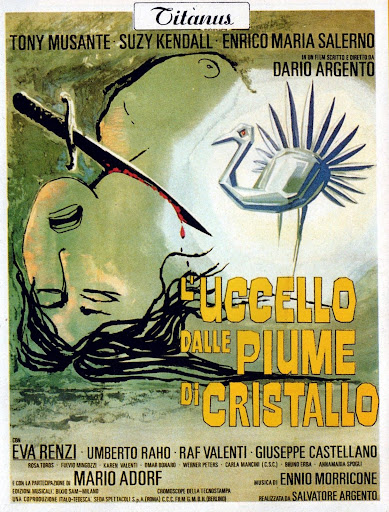
It's appropriate then that one of [BU's] first Blu-ray releases should be what might be considered the seminal (though not the first) giallo film, Dario Argento's The Bird with the Crystal Plumage (L'Uccello dale piume cristallo, 1970). Though many of its then-innovative components have since become genre cliches, it's still an impressive work with extremely good cinematography. Blue Underground's transfer is fine and the extras, though carried over from an earlier DVD release, are plentiful and informative.

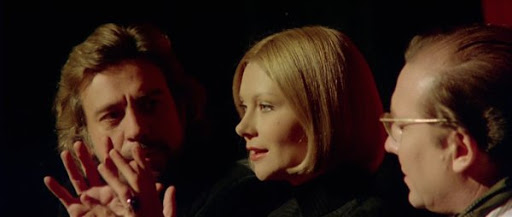
Sam Dalmas (Connecticut-born Tony Musante) is a novelist living in Rome. He has writer's block and no wonder - his girlfriend, Julia (Suzy Kendall), is a beautiful British model.


dario argento- the bird with the crystal plumage

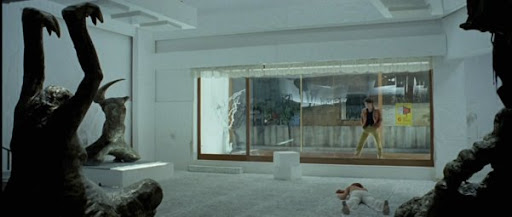
Shortly before they plan to return to the U.S., Sam is walking the streets late at night when across the road, through the floor-to-ceiling glass windows of an art gallery, he sees a woman being stabbed by someone in a dark raincoat, who then disappears through a back door. Sam rushes to the woman's rescue, but finds himself trapped between the two glass doors leading into the gallery.

The woman, Monica (Eva Renzi), the wife of gallery owner Alberto Ranieri (Umberto Raho), survives the attack, and the following day Police Inspector Morosini (Enrico Maria Salerno, whose upper lip hair suggests a hot chocolate mustache) takes possession of Sam's passport, preventing the writer from leaving the country during the ongoing investigation. For his part, Sam begins to suspect Alberto, but in any case both Sam and Julia become the target of further attacks. Meanwhile, Sam is haunted by nagging memories of what he saw that night, convinced he's somehow not registering a vital detail that might solve the mystery.

The Bird with the Crystal Plumage was Dario Argento's first credit as director. Before this he worked as a screenwriter for several years, notably on Once Upon a Time in the West, in which he collaborated with Bernardo Bertolucci and director Sergio Leone. After Mario Bava's death Argento became Italy's leading horror filmmaker, but it was during the '70s, in films where he merged giallo with horror and surrealism, that Argento made most of his best films, famously Suspiria and Deep Red.


dario argento- the bird with the crystal plumage

The Bird with the Crystal Plumage is a good showcase for Argento's talent though personally I much prefer his next film, The Cat o' Nine Tails (Il gatto a nove code, 1971), which is more confidently stylized and has better performances (by James Franciscus, Catherine Spaak, and especially Karl Malden). Tony Musante, who has a tendency to overact, oddly is too subdued and uncharismatic here, delivering one of the least interesting leading performances in the genre. Nevertheless, The Bird with the Crystal Plumage was a big hit in Italy and to some degree abroad. Wikipedia reports a budget of $500,000 but I'd be surprised if it was half that. An Italian-West German co-production filmed in English - which accounts for the appearance of ubiquitous German character actor Werner Peters, late of myriad Edgar Wallace thrillers, as a gay antique dealer - the film was a big hit, earning about 1.6 billion lire in Italy alone at a time when Mario Bava's much less expensive thrillers weren't even making back their negative cost.

There are many fine set pieces: a line-up scene featuring a masculine transvestite amusingly calling herself "Ursula Andress"; a fall from an apartment window daringly filmed by tossing the camera out the window and letting crash onto the pavement below; an amusing chase of an assassin (creepy-looking Hitchcock veteran Reggie Nalder, no less) who disappears into the crowd at a boxing commission meeting, where everyone's wearing the same style of blue cap and yellow jacket. The scenes at the austere gallery are the film's highlights, with its proscenium framing also suggesting a reptile's aquarium, with rubber-necking passersby peering into the crime scene. The stabbing of Monica and Sam's inability to reach her is extremely well staged and visually very interesting.


dario argento- the bird with the crystal plumage

Technical Information:

Title: L'uccello dalle piume di cristallo/The Bird with the Crystal Plumage
Year: 1970
Country: Italy, West Germany
Director: Dario Argento

Source: Retail BluRay
Video Codec: 1080p-x264
Container: .mkv
Size: 6.55 GB
Length: 1:36:30
Programs used: mkvmerge

Resolution: 1920x816
Aspect Ratio: 2.35:1
Video: MPEG4 AVC H264 @ ~9727 kb/s
Frame Rate: 23.976 fps

Audio: Italiano- Dolby AC3 5.1 @ 448 kb/s
Subtitles: English


dario argento- the bird with the crystal plumage

(Our prefered x264 player is Media Player Classic.)
(Use JDownloader to automate downloading)

L'uccello dalle piume di cristallo Megaupload Links