


I was supposed to post Fly some time during last Christmas, but Jesus Week and a night of hard drinking while attempting to make the post left a train wreck cowering in "draft mode"...until tonight.
When I posted the last Yoko Ono album a ways back, I complained that it should have been "a little more experimental." Well, I got my wish, didn't I. Fly moves from sub-Saharan affected dog yelps to vocal Metal Machine Music, followed by bare-wire ballads and phone rings and Maenad glossolalia. This leaves one to wonder if Bjork put the royalty check in the mail. Fly is some brilliant, brilliant stuff.
Like I said in my drunken post that you'll never see..."Yoko OnI iz a FUKING GodAss!" Excuse my French and enjoy the album.

From Tim Harris at Rolling Stone, 1971:
Yoko's new offering, unlike her husband's, is a two-record set. I admit to a bias against double albums, which often seem to represent only an inadequate solution to the problem of what to leave out. That prejudice declared, I have to say that I found it impossible to listen attentively to this whole album more than once. It's hard to guess why Yoko found it necessary to take up so much vinyl to state her case.
The title song, "Fly," which originally accompanied the perambulations of an intoxicated fly over a woman's nude body in Yoko's film, takes nearly 23 minutes. Most of it is unaccompanied. Yoko's voice exhibits moments of considerable virtuosity, originality and wit, but I doubt that any but a single-minded student of her music could sit through it more than a couple of times. Some of the shorter songs — "Don't Worry Kyoko," and "Mind Train" — are livened by a strong rock accompaniment, but don't seem to show a significant development from Yoko's previous album.
In the course of the four sides there are some nice things. "Mind Holes" has a pair of fine opentuned acoustic guitar tracks by John and a soaring, ghostly vocal by Yoko. In "O'Wind (Body is the Scar of Your Mind)," Yoko does a highly vigorous performance, set against involuted percussion.

"Airmale" is a ten-minute experimentation in studio effects, primarily tape delay, one of John and Yoko's favorite devices. It's eerie enough, but then, no electronic effect is easier to achieve than eerieness.
The most orthodox cut is "Mrs. Lennon," a straight melody which Yoko sings in a pretty voice, much as Adolf Gottlieb might paint a little portrait to show the untutored that he doesn't have to do abstracts. Yoko's voice is diffused and diminished by excessive reverberation, which she doesn't need.
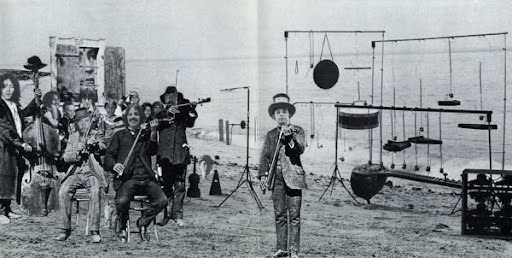
The Joe Jones Tone Deaf Music Co. appears on three of the album's 13 cuts, for which Yoko is owed thanks. They are fascinating, and the rest of the studio work is top-rate as well: Ringo, Eric Clapton. Klaus Voorman, Jim Keltner, Jim Gordon, Bobby Keyes, Chris Osborne. John plays guitar with his customary freshness, as though he had just been handed the instrument after a year of enforced separation.

But all in all it just doesn't hold up. The problem is not necessarily that Yoko is uncreative or that her voice is less than unique and amazingly dexterous. Until she and John start producing her stuff with a more dispassionate attitude, with less of a conspicuous effort to demonstrate their respect for one another, I doubt that anyone will really know how creative she is. The problem is that nobody involved with this record seems to have asked hard questions about what is first-rate and what is not, what is original and what is merely repetitive.
Two short interludes on the record illustrate this in a particularly depressing way: One consists of the sound of a toilet flushing. The other, at the end of side four, is a telephone. It rings six times. Then Yoko's voice: "Hello. This is Yoko." That's all. It would be interesting to know whether anyone anywhere regards these touches as inspiring, or funny, or cute, or revealing, or anything but tiresome.
I don't believe that Yoko's music is the music of the future, as some of her fans say, but it isn't noise, either, as some of her critics say. It is serious work, often rewarding of close attention, better listened to alone than in groups, and capable at its best of expanding one's idea of certain kinds of musical horizons. It has considerable potential, which is why I wish Yoko would start discriminating between what she can and cannot do well. The results might well be more surprising than what she has done so far.

Technical Information:
Artist: Yoko Ono with Plastic Ono Band
Album: Fly
Year: 1971
Audio Codec(s): FLAC
Encoding: Lossless
Rip: EAC split tracks
Avg. bitrate:
Disc 1- 871 kb/s
Disc 2- 784 kb/s
Sample rate: 44100 Hz
Bits per sample: 16
Channels: 2
File size:
Disc 1- 262 MB
Disc 2- 299 MB
Length:
Disc 1- 0:42:04
Disc 2- 0:53:20
Tracklisting:
Disc 1:
01. Midsummer New York (3:52)
02. Mindtrain (16:53)
03. Mind Holes (2:47)
04. Don't Worry Kyoko (Mummy's Only Looking for her Hand in the Snow) (4:55)
05. Mrs. Lennon (4:12)
06. Hirake (3:32)
07. Toilet Piece- Unknown (0:31)
08. O'Wind (Body Is the Scar of Your Mind) (5:23)
Disc 2:
01. Airmale (10:43)
02. Don't Count the Waves (5:25)
03. You (8:59)
04. Fly (22:52)
05. Telephone Piece (0:38)
06. Between the Takes (1:58)
07. Will You Touch Me (2:45)

Fly Megaupload Links:
Disc 1
Disc 2